
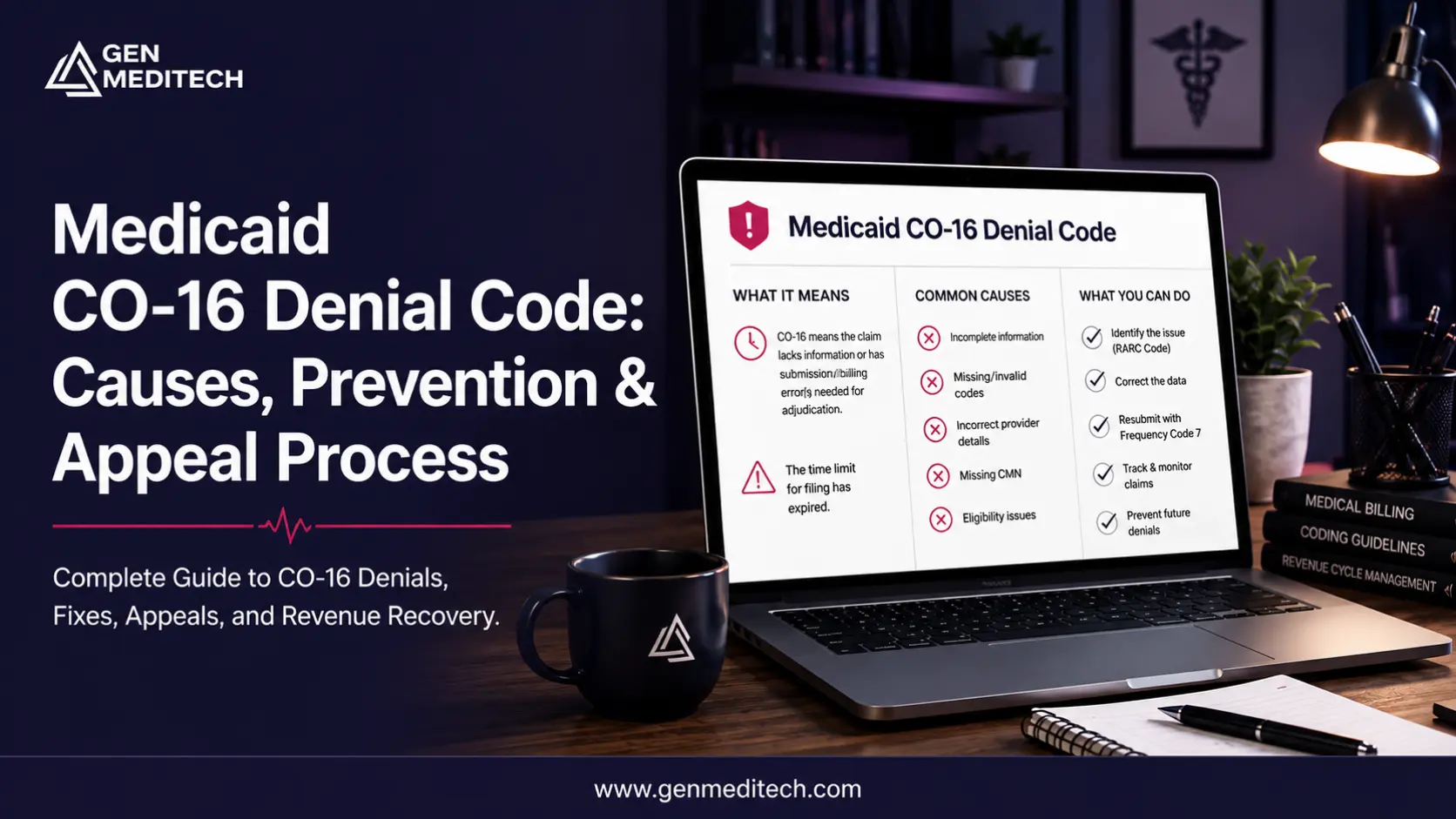
Getting a CO-16 denial code on a claim stops payment immediately. The ERA shows the code, the billing team opens the file, and the question is always the same, what went wrong and how do we fix it fast?
The CO-16 denial code means the claim is missing information or contains a billing error the payer cannot work around. But the code itself does not say what the problem is. That answer lives in the Remittance Advice Remark Code (RARC) sitting right beside it on the ERA. Read that first, fix the right field, and most CO 16 denial code cases close in days.
This guide covers the full CO-16 denial code description, all 15 common RARCs, a 7-step fix workflow, the timely filing risk most teams miss, and everything needed to stop CO-16 before it starts. For context on how timely filing rules work across all payers, see the Medical Insurance Claim Filing Time Limits guide.
What Is the CO-16 Denial Code?
The official CO 16 denial code description from X12 standards is:
“Claim/service lacks information or has submission/billing error(s) which is needed for adjudication.”
Three things every billing team needs to understand before anything else:
CO stands for Contractual Obligation: The provider is responsible for the adjusted amount. The patient cannot be billed. Attempting to collect from a patient on a CO-16 write-off violates the payer contract and creates compliance risk.
CO-16 is a wrapper code: The code signals something is wrong. It does not say what. The RARC on the ERA is the real diagnosis.
- CO-16 with N264 means an ordering provider name problem
- CO-16 with M60 means a missing Certificate of Medical Necessity
- CO-16 with MA27 means a Medicare entitlement mismatch
Each one needs a completely different fix. Treating them the same is exactly why the same claim gets denied twice.
CO-16 is a denial, not a rejection: The claim reached the payer. The timely filing clock did not pause. It kept running from the original date of service, and that is where the real financial risk sits.
Some billers search for “PI 16 denial code” when looking for this code. PI stands for Payer Initiated adjustments and is a separate group code. The correct code for missing or invalid claim information across Medicare, Medicaid, and commercial payers is CO-16.
CO-16 Denial vs Rejection: Why This Difference Matters
This distinction is where practices quietly lose revenue they should have collected.
| Rejection | CO-16 Denial | |
| Did the claim reach the payer? | No | Yes |
| Timely filing clock | Paused or reset depending on payer | Keeps running from original DOS |
| How to fix | Correct and resubmit as new claim | Corrected claim using Frequency Code 7 |
| Can the team appeal? | No | Yes, but rarely the right move |
A CO-16 sitting in a denial queue for 20 days has already used 20 days of the filing window. In states where Medicaid allows only 90 to 95 days from the date of service, that gap becomes critical fast.
Common Causes of CO-16 Denial Code
Most CO 16 denial code cases start at the front desk or inside the EMR. The biller sees the denial last, but the problem almost always starts first.
| Root Cause | Real-World Examples |
| Patient demographic mismatch | Wrong date of birth, transposed member ID digits, name spelled differently than the insurance card |
| Missing or expired authorization | Prior auth not obtained, auth number left off the claim, authorization expired before the service date |
| Provider information errors | Wrong NPI, inactive taxonomy code, ordering provider name does not match PECOS format |
| Diagnosis to procedure mismatch | ICD-10 code does not support the CPT billed, incorrect diagnosis sequencing |
| Modifier and formatting errors | Missing modifier 25, 59, LT or RT, wrong place of service code in Box 24B |
| 837 electronic file errors | Required loops left blank, data placed in wrong segment, payer-specific fields missing |
If the CO-16 denial code rate is above 3 percent of total claims, something upstream in the workflow is consistently failing, and the fix is not in the billing department.
How 837 Electronic File Errors Trigger CO-16?
This is the piece most billing guides skip, and it explains why some CO-16 denials appear even when the paper claim looks completely correct.
When a claim goes out electronically, it travels as an 837 file. Professional claims use the 837P format. Facility claims use the 837I format. Every data element must appear in the exact correct loop and segment within that file.
Common 837 related issues that trigger the CO-16 denial code:
- Required data loops left completely blank
- Invalid values placed in key fields
- Patient or provider details entered in the wrong segment
- Situational fields skipped when that specific payer requires them
The clearinghouse may accept the 837 file and send a confirmation. The payer’s adjudication system can still fail the claim at a separate checkpoint. Clearinghouse acceptance is not the same thing as a clean claim.
Before resubmitting any CO 16 denial code case, confirm the corrected data landed in the right loop and segment inside the 837 file, not just on the paper CMS-1500 form.
CO-16 RARC Decoder: What Each Remark Code Actually Means?
The RARC is the most important piece of information in any CO-16 denial code case. Always read it before touching the claim.
N codes point to patient or provider information problems. M codes point to claim level or documentation problems.
Here are the 15 RARC codes that cover the large majority of CO-16 denials, with the exact fix and the CMS-1500 field where the problem lives:
| RARC | What It Means | Exact Fix | CMS-1500 Box |
| M12 | Purchased diagnostic test info missing | Add purchase information to the claim | Box 20 |
| M51 | Invalid or missing procedure code | Recode with valid CPT or HCPCS | Box 24D |
| M60 | Missing CMN or DME DIF | Attach signed Certificate of Medical Necessity | Attachment |
| M77 | Invalid place of service | Correct the POS code | Box 24B |
| M79 | Invalid charge amount | Enter the charge for each service line | Box 24F |
| M124 | Missing indication of whether patient owns the equipment requiring the part or supply | Add explicit Yes or No ownership indicator confirming patient owns the primary device | Box 19 |
| MA27 | Invalid Medicare entitlement name or number | Match the Medicare card exactly | Box 1a |
| MA30 | Invalid or incomplete type of bill | Correct the TOB code in Form Locator 4 (FL 04) | UB-04 FL 04 |
| MA31 | Invalid service dates | Match Box 24A to the medical record | Box 24A |
| MA63 | Invalid diagnosis code | Add the correct ICD-10 that supports the CPT | Box 21 |
| MA83 | Medicare primary or secondary info missing | Complete Box 11 correctly | Box 11 |
| N264 | Ordering provider name missing or invalid | Use the exact PECOS format including middle initial | Box 17 |
| N265 | Ordering provider NPI invalid | Verify in NPPES registry and correct | Box 17b |
| N290 | Rendering provider ID invalid | Match NPI to the actual rendering provider | Box 24J |
| N575 | Provider name does not match payer records | Match exactly to what the payer has on file | Box 31 or 33 |
If the ERA shows a RARC not listed here, the full RARC index is maintained by X12.org and updated regularly by CMS.
Who Is Responsible for CO-16 Denials?
The CO-16 denial code is not always a biller mistake. The problem almost always starts before the claim reaches the billing team.
- Front desk captures patient demographics, insurance IDs, and authorization numbers at registration
- Provider or ordering physician generates documentation, referrals, and orders
- Biller prepares and submits the claim using information from both sides
When any one step fails, the CO-16 appears at the end and the biller fixes a problem they did not create.
| Where the Failure Happened | CO-16 It Causes |
| Front desk entered wrong date of birth | Demographic mismatch or MA27 denial |
| Front desk did not capture the authorization number | Blank auth field triggers CO-16 or CO-197 |
| Provider ordering name does not match PECOS | N264 or N575 on every related claim |
| Biller resubmitted denied claim as a new claim | CO-18 denial added on top of CO-16 |
| EMR auto-populates 837 without middle initial | N264 on every claim from that provider |
Fixing blame does not fix the workflow. Assigning ownership at each step does.
How to Fix a CO-16 Denial: 7-Step Workflow
Work every CO-16 denial code through this sequence in order. Skipping steps is how the same claim gets denied a second time.
Step 1: Pull the ERA, Not the Paper EOB
The paper Explanation of Benefits shows the CO-16 and the RARC. The 835 ERA file contains loop 2110 detail that identifies the exact field that failed. Open the clearinghouse portal and pull the electronic remittance. Working from a scanned paper EOB means working with less information than the payer actually provided.
Step 2: Read the RARC Before Touching Anything
M51 and N264 look similar at a glance. One is a coding problem. The other is a provider data problem. They need completely different corrections. Match the RARC against the decoder table above before making any changes to the claim.
Step 3: Compare the Submitted Claim to Source Documents
Pull the original claim and the patient chart side by side. Most CO 16 denial code cases become visible immediately at this step. The insurance card has a newer member ID. The provider name is formatted differently in the EMR than in PECOS. A modifier from the superbill did not transfer to the claim.
Step 4: Verify Payer-Side Data
For Medicare claims, check PECOS directly at pecos.cms.hhs.gov. For commercial payers, log into the payer portal and confirm how the patient and provider are listed.
“John Smith MD,” “John Smith, MD,” and “John A. Smith MD” are three different entities to most payer adjudication systems. Match character by character.
Step 5: Decide Between Corrected Claim and Appeal
See the next section for how to make this call correctly.
Step 6: Resubmit Using Frequency Code 7, Not a New Claim
| Frequency Code | When to Use |
| 1 | Original claim, first submission only |
| 7 | Corrected or replacement claim, use this for every CO-16 fix |
| 8 | Void or cancel a previously submitted claim |
Resubmitting a denied claim as a new claim (Code 1) creates a duplicate. The payer issues a CO-18 denial on top of the original CO-16. Now there are two problems at work instead of one.
Step 7: Track the Timely Filing Clock
Work CO-16 denials within 5 business days of receiving the ERA. The timely filing window does not pause for corrections. A CO 16 denial code that sits past the filing deadline becomes a permanent write-off, even if the underlying service was legitimate and completely fixable.
Corrected Claim vs Appeal for CO-16: How to Decide
Most CO-16 denial code cases should be resubmitted as corrected claims. Here is how to make the right call:
| Situation | Correct Action |
| Original claim had missing or incorrect data | Corrected claim using Frequency Code 7 |
| Original claim was complete and accurate, payer denied in error | Formal appeal |
| Authorization was missing but can be obtained retroactively | Appeal with retro auth and supporting documentation |
When an appeal is needed, include:
- The ERA showing the specific RARC
- The original submitted claim
- Documentation proving the original data was correct
- A short cover letter referencing the specific remark code
What to never do in a CO-16 appeal: Do not argue medical necessity. CO-16 is not a medical necessity denial. The payer is not questioning the clinical service. They are saying a required field was wrong or missing. Arguing clinical justification wastes time and almost never succeeds on a CO 16 denial code appeal.
A Real CO-16 Pattern We See Repeatedly
Understanding the pattern matters far more than fixing individual claims.
The scenario:
- Multi-provider internal medicine practice
- Around 2,400 claims per month
- CO-16 rate sitting at 11 percent
- 90-day audit revealed 68 percent of those CO-16 denials carried RARC N264
- Every single one traced back to three ordering providers
The root cause:
- Practice credentialed those three physicians in PECOS using their full names with middle initials
- EMR was configured to auto-populate the 837P file without the middle initial
- Every lab order routed through those providers failed the name match at Medicare
The fix:
- One EMR template change to force middle initial inclusion
- Cleared over 80 percent of that practice’s CO-16 denials in the next billing cycle
The lesson:
A biller working claims one at a time, corrects the claim, resubmits, then sees the same N264 denial the following week from the same provider. The pattern never gets fixed because no one is looking at it.
Denial management done right finds the cluster first, fixes the upstream cause, then clears the back queue.
CO-16 and the Timely Filing Clock: The Hidden Revenue Risk
This is the angle that costs the most money and that most CO-16 guides never cover in enough detail.
CO-16 does not pause the initial timely filing clock.
The original date of service starts at the first clock. It keeps running regardless of denials or corrections in the queue. However, most state Medicaid programs grant a separate correction window from the date of the remittance notification once an initial denial hits, provided the original claim went out on time.
This means two deadlines are in play on every CO-16 denial:
- Initial window: counted from the original date of service
- Correction window: counted from the ERA notification date after the denial
Missing either one turns a fixable claim into a permanent write-off.
| State | Initial Window (from DOS) | Correction Window (from ERA Date) |
| New York | 90 days | 60 days from notification date |
| Texas | 95 days | 180 days from notification date |
| Iowa | 90 days | 365 days from initial processing date |
| Massachusetts | 90 days | 90 days from remittance date |
| New Mexico | 90 days | Verify with MCO contract |
| Maine | 120 days | Verify with state FFS manual |
Always keep the clearinghouse acceptance confirmation and ERA date. The original submission timestamp proves the initial window was met. The ERA date starts the correction clock. Without both, the write-off stands and there is no documentation to dispute it.
For complete state-by-state Medicaid filing windows and MCO-specific rules, see the Medicaid Timely Filing Limit guide.
CO-16 vs Similar Denial Codes: How to Tell Them Apart
Getting the code wrong means working the wrong fix. These are the denial codes most commonly confused with CO-16:
| Code | What It Signals | Key Difference from CO-16 | Correct Action |
| CO-16 | Missing or invalid claim information | Fix the data, resubmit corrected | Corrected claim, Frequency Code 7 |
| CO-18 | Exact duplicate claim | Already processed, do not resubmit again | Void or adjust only |
| CO-22 | Coordination of benefits issue | Another payer is primary, not a data field problem | Fix COB sequencing, then resubmit |
| CO-29 | Timely filing limit exceeded | About the deadline, not missing data | Appeal with proof of original filing |
| CO-97 | Service bundled under another code | NCCI bundling issue, not missing information | Check bundling edits |
| CO-109 | Claim sent to wrong payer | Routing issue, not a data error | Send to the correct carrier |
| CO-197 | Missing prior authorization | Authorization issue, not a claim field error | Obtain or appeal authorization |
CO-29 and CO-16 often appear together in Medicaid billing. CO-16 means the claim had bad data. If that claim was not corrected and resubmitted in time, CO-29 follows. One denial creates the next. For a full breakdown of how CO-29 works and how to appeal it, see the Medicaid CO-29 Denial Code guide.
CO-16 Denial Rate Benchmarks — What Is Normal vs Alarming
Tracking CO-16 as a separate metric gives practices a clear signal about where the workflow stands.
| CO-16 Rate | What It Signals |
| Under 2% | Workflow is clean. No urgent action needed. |
| 2% to 5% | Monitor closely. Likely one payer, provider, or CPT cluster causing the spike. |
| 5% to 10% | Front-end workflow is broken. Immediate audit required. |
| Above 10% | Systemic failure. Usually an EMR configuration or credentialing setup problem. |
Specialties with the highest CO-16 rates:
| Specialty | Why CO-16 Hits Harder Here |
| DME | Strict ordering provider PECOS requirements, CMN documentation rules |
| Behavioral and Mental Health | Complex auth rules, multi-provider NPI matching, tight diagnosis alignment |
| Diagnostic and Lab | Ordering provider chain, purchased service disclosure requirements |
| Oncology | Drug authorization, ICD-10 specificity requirements for chemotherapy claims |
| Telehealth | POS code 02 vs 10 confusion, credentialing gaps with newer payers |
If the practice falls into one of these specialties and the CO 16 denial code rate is above 3 percent, the root cause is almost always in provider data or authorization capture, not in the billing process itself.
How to Prevent CO-16 Denials Before the Claim Is Submitted?
Prevention eliminates the denial before it starts. Correction fixes it after revenue has already been delayed.
Front-End Prevention on the Day of Service
- Run a real-time eligibility check on the same day as the appointment, not just at registration
- Verify the active plan, subscriber ID, and patient demographics match the insurance card exactly
- Capture authorization numbers at the time of service before the patient leaves
- Confirm the ordering provider name matches PECOS before any referral or order is generated
Provider Data Audit Every 90 Days
Compare EMR provider records against:
- PECOS for all ordering and referring providers
- NPPES for NPI numbers and taxonomy codes
- Each commercial payer portal for enrollment status and name formatting
Any drift in names, NPIs, or taxonomy codes causes N264, N265, N290, or N575 denials. A quarterly sync takes a few hours and prevents hundreds of CO-16 denials over the next quarter.
Claim Scrubbing Beyond the Clearinghouse
- Clearinghouse edits catch formatting errors only
- Payer-specific scrubbing catches the CO 16 denial code cases that actually hit the practice
- Apply payer-specific rules in addition to generic clearinghouse edits
- Review each payer’s provider manual at least once a year since requirements change
Denial Pattern Reporting Every Month
- Track CO-16 separately, broken down by RARC, by provider, by payer, and by CPT
- Look for clusters, not individual claim issues
- If N264 keeps appearing on claims from the same two providers, the root cause is an EMR configuration issue, not a biller error
- Fixing the cluster prevents the next 200 denials. Fixing one claim prevents one.
CO-16 in Different Payer Types
CO-16 in Medicare
Medicare has some of the strictest data requirements, particularly for ordering and referring providers.
- PECOS enrollment is mandatory. If the ordering provider is not enrolled, the claim fails at adjudication regardless of everything else being correct.
- N264 and N265 are the most common RARCs on Medicare CO-16 denials
- The 835 ERA loop 2110 contains the most detailed field-level information for Medicare claims, always pull it before attempting any correction
- Medicare’s initial timely filing limit is 12 months from the date of service. After a CO-16 denial, the corrected claim or reopening request must generally be submitted within 1 year from the ERA date or the original DOS filing window, depending on MAC rules. Waiting until the deadline puts the claim at risk, the 12-month limit is a boundary, not recovery time.
Reference: CMS Medicare Claims Processing Manual, Chapter 1
CO-16 in Medicaid
Medicaid CO-16 denials carry the most urgency because most state Medicaid programs run on short filing windows.
- Requirements vary significantly from state to state
- MCO plans within the same state often add data requirements beyond the state fee-for-service program
- A CO-16 in New York Medicaid received on day 30 of a 90-day window leaves 60 days to correct and resubmit — manageable only if worked immediately
- Texas Medicaid follows a similar pattern with its 95-day window
For state-by-state Medicaid deadlines and MCO-specific rules, see the Medicaid Timely Filing Limit guide.
CO-16 in Commercial Payers
- Authorization requirements vary across BCBS, UnitedHealthcare, Aetna, Cigna, and Humana
- Each payer maintains its own required fields beyond standard CMS-1500 rules
- Payer-specific scrubbing rules matter more here than generic clearinghouse edits
- Review each payer’s provider manual annually since requirements change regularly
When Your CO-16 Rate Signals You Need Expert Help?
Some CO-16 problems are single-claim issues. Others are systemic failures that an in-house team working claims one at a time will never fully resolve.
Under 2% CO-16 rate with A/R days under 35: The in-house team is performing well. Do not change what is not broken.
CO-16 rate climbing past 5%: The denial team is reactive, not pattern-focused. That gap compounds every month and costs more than it appears on the surface.
Above 10%, or a key biller just left: Outside expertise pays for itself quickly. A denial specialist working across 30 or 40 practices sees patterns that a single in-house biller will never encounter. That exposure is what closes a stubborn CO 16 denial code rate in weeks, not months.
GenMediTech’s AR and Denial Management Services and AI Denials Management are built specifically for finding the cluster behind a rising CO-16 rate, fixing the upstream workflow cause, and clearing the back queue.
If the CO-16 rate is above 5 percent, the problem is not the individual claims. It is the workflow producing them.
Conclusion
The CO-16 denial code is one of the most common and most fixable denials in medical billing. But fixable only means something when the team knows where to look first.
Three things that matter most:
Read the RARC first. CO 16 denial code without the RARC tells the team nothing. With it, the correction is usually straightforward.
Act within 5 business days. In New York, Texas, Iowa, Massachusetts, and New Mexico, the initial Medicaid window is 90 to 95 days from the date of service. Missing that window with the original claim is a guaranteed write-off. States do grant secondary correction windows from the ERA date, but only if the original claim was filed on time.
Fix the pattern, not just the claim. Practices that keep CO-16 rates under 2 percent run day-of-service eligibility checks, audit provider data quarterly, apply payer-specific scrubbing, and review denial patterns every month. The denial code is the symptom. The workflow is the cause.
Frequently Asked Questions
What is the denial code CO-16?
CO-16 means the claim is missing required information or contains a billing error that stopped the payer from processing it. Read the RARC on the ERA to find the exact field that failed, fix it, and resubmit using Frequency Code 7.
What is the full CO-16 denial code description?
The official CO 16 denial code description is: “Claim/service lacks information or has submission/billing error(s) which is needed for adjudication.” CO is a Contractual Obligation code — the adjusted amount is the provider’s responsibility, not the patient’s.
What is a CO-18 denial code?
CO-18 means the payer already processed this exact claim and is treating the new submission as a duplicate. Do not resubmit again. CO-18 commonly appears when a CO-16 denial was resubmitted as a new claim using Frequency Code 1 instead of a corrected claim using Frequency Code 7.
What is the denial code CO-16 M51?
CO-16 with RARC M51 means the procedure code on the claim is missing, incomplete, or invalid. Pull the patient chart, verify the correct CPT or HCPCS code, update Box 24D on the CMS-1500, and resubmit as a corrected claim.
What is reason code 16 for Medicare?
Reason code 16 for Medicare means the claim lacks required information or contains a submission error. CMS requires at least one RARC to accompany this code on every Medicare remittance. The RARC identifies which specific field failed so the correction can be made without guessing.
What RARC codes come with CO-16?
The most common are N264 (ordering provider name), MA27 (Medicare entitlement), M60 (missing CMN), N575 (provider name mismatch), and N265 (ordering provider NPI). The RARC identifies exactly what to fix. Always read it before making any changes.
Should a CO-16 denial be resubmitted or appealed?
Resubmit as a corrected claim using Frequency Code 7 in almost every case. Appeal only if the original claim was accurate and complete and the payer denied it in error.
Does CO-16 reset the timely filing clock?
No. The original date of service clock keeps running. In states like New York and Texas where Medicaid allows only 90 to 95 days, CO-16 must be worked within days of receipt, not weeks.
Can the patient be billed for a CO-16 denial?
No. CO-16 is a Contractual Obligation adjustment. Billing the patient violates the payer contract and creates compliance risk. The provider must correct and resubmit or write off the balance.
What is the difference between CO-16 and CO-29?
CO-16 means the claim had bad data. CO-29 means the claim missed the filing deadline. A CO-16 left too long becomes a CO-29. See the Medicaid CO-29 Denial Code guide for the full breakdown.
What does CO-16 with N264 mean?
The ordering provider name on the claim is missing or does not match PECOS records. Verify the exact name format in PECOS including middle initials, correct the 837 file, and resubmit as a corrected claim.
What is the difference between CO-16 and CO-18?
CO-16 means the claim has missing or invalid data and needs correction. CO-18 means the payer already processed this claim and sees the new submission as a duplicate. CO-18 on top of CO-16 almost always means the team resubmitted the denial as a new claim instead of a corrected claim.
How long does a provider have to fix a CO-16 denial?
Work CO-16 within 5 business days of receiving the ERA. Medicare’s initial filing limit is 12 months from DOS, while denied claims like CO-16 generally allow 1 year from the ERA date for correction or reopening (per MAC rules). Medicaid limits are often 90–95 days from DOS, with correction windows depending on the payer. Missing these deadlines can eliminate recovery options.
Are CO-16 denials more common in certain specialties?
Yes. DME, behavioral health, diagnostics, oncology, and telehealth see the highest rates because of strict PECOS requirements, CMN documentation rules, and complex authorization workflows.
What is the CO 16 denial code solution?
Read the RARC, fix only the field that failed, and resubmit using Frequency Code 7. For repeated CO-16 denials, track by RARC and by provider to find the upstream pattern and fix the root cause rather than working claims one at a time.
What is the PI 16 denial code?
PI is a separate group code standing for Payer Initiated adjustments. The standard code for missing or invalid claim information across Medicare, Medicaid, and commercial payers is CO-16. If the ERA shows CO-16, the CO group code guidance applies.
References
- Centers for Medicare and Medicaid Services — Claim Adjustment Reason Codes and Remittance Advice Remark Codes: https://www.cms.gov/medicare/coding-billing/electronic-billing-edi-transactions/remittance-advice-remark-reason-codes
- X12 Remittance Advice Remark Code Official List: https://x12.org/codes/remittance-advice-remark-codes
- CMS PECOS Provider Enrollment and Ordering and Referring Provider Information: https://pecos.cms.hhs.gov
- NPPES National Plan and Provider Enumeration System NPI Registry: https://npiregistry.cms.hhs.gov
- CMS Medicare Claims Processing Manual Chapter 1 — Timely Filing Policy: https://www.cms.gov/Regulations-and-Guidance/Guidance/Manuals/Downloads/clm104c01.pdf
- CMS 1500 Claim Form Instructions and Requirements: https://www.cms.gov/medicare/cms-forms/cms-forms/cms-forms-items/cms1188
- X12 837P and 837I Transaction Set Standards: https://x12.org/products/transaction-sets
- Noridian Medicare Denial Resolution Reference for RARC M124-16: https://med.noridianmedicare.com/web/jddme/topics/ra/denial-resolution/m124-16
- CMS RARC and CARC Complete Reference List: https://www.cms.gov/Medicare/Medicare-Fee-for-Service-Payment/PhysicianFeeSched/Downloads/RARC.pdf
- American Medical Association CPT and Medical Billing Standards: https://www.ama-assn.org/practice-management/cpt