
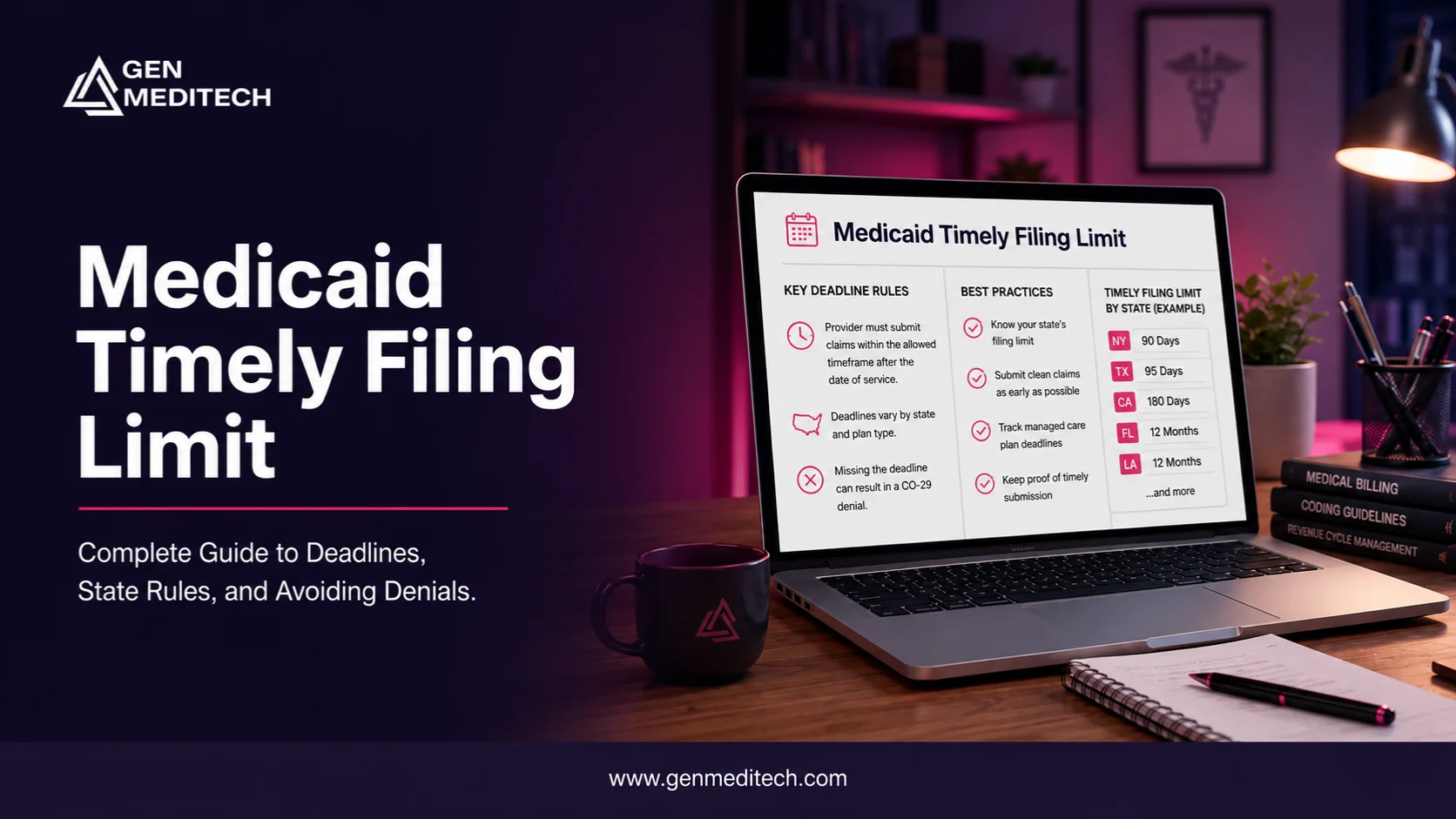
Every day, healthcare providers lose thousands of dollars, not because their services were wrong, but because a Medicaid claim arrived one day late. The Medicaid timely filing limit is the deadline a provider has to submit a claim for reimbursement. Miss it, and Medicaid denies the claim. No correction fixes it. No appeal reverses it in most cases. The revenue is simply gone.
What makes Medicaid different from Medicare is simple: there is no single national deadline. Every state runs its own Medicaid program, sets its own filing window, and writes its own rules for corrected claims, coordination of benefits, and appeals.
This 2026 guide covers every state’s Medicaid timely filing deadline, the difference between fee-for-service and managed care plans, corrected claim rules, COB timelines, CO-29 denial code, Louisiana’s unique official requirements, and best practices to keep your billing team ahead of every deadline.
What Is a Medicaid Timely Filing Limit?
A Medicaid timely filing limit is the maximum number of days a provider has to submit a claim after delivering services. Submit after this deadline and Medicaid denies it, regardless of whether the service was medically necessary and properly documented.
The clock does not start when documentation is finished or when the patient pays their co-pay. It starts the moment care is delivered.
| Scenario | When the Clock Starts |
| Standard outpatient claim | Date of service |
| Inpatient or facility claim | Discharge date |
| COB / secondary Medicaid claim | Date of primary payer’s adjudication or EOB receipt |
| Retroactive eligibility case | Date retroactive coverage was confirmed |
Timely filing rules apply to more than just initial claims. They also govern:
- Corrected and adjusted claims
- Coordination of benefits (COB) secondary claims
- Reconsideration requests
- Formal appeals
Key distinction: Unlike Medicare which operates under a single federal rule, 42 CFR § 424.44, requiring claims within 12 months nationwide Medicaid has no uniform national deadline. Each state sets its own Medicaid timely filing rules. A deadline that works for Minnesota Medicaid will not protect you when billing Texas Medicaid.
Why Medicaid Timely Filing Limits Differ by State?
Medicaid is jointly funded by the federal government and individual states. While the federal government sets the overall framework, each state administers its own program and writes its own billing policies.
Several factors cause Medicaid timely filing limits to vary state by state:
- State regulations and budget cycles: some states build longer windows to reduce administrative burden on providers
- Managed care contracts: MCOs within the same state can set shorter limits than the state’s fee-for-service program
- Claim processing systems: Pennsylvania uses the PROMISe system; Georgia providers bill through GAMMIS, each has its own portal rules
- Provider type and specialty: behavioral health, telehealth, skilled nursing, and FQHC claims can carry different filing rules within the same state
- COB situations: when Medicaid is secondary, the clock often starts from the primary payer’s response date, not the date of service
A billing workflow designed for one state Medicaid program can create denials when applied to another. Providers working across multiple states or with several MCOs in one state, must treat each payer’s filing window as a completely separate rule.
Medicaid Timely Filing Limits (2026 Quick Reference)
Before the full state-by-state breakdown, here is how Medicaid timely filing limits compare across plan types in 2026.
| Payer / Plan Type | Typical Filing Limit (2026) |
| Medicare (for comparison) | 12 months — federal rule, uniform |
| Medicaid Fee-for-Service (FFS) | 90 days to 12 months (state-specific) |
| Medicaid Managed Care (MCO) | Per MCO contract — often 90 to 180 days |
| Dual Eligible (Medicare + Medicaid) | Medicare rules apply first; Medicaid secondary clock starts from primary EOB |
| Humana Medicaid | Varies by state contract |
| Molina Healthcare Medicaid | Varies by state contract |
| Centene / WellCare Medicaid | Varies by state contract |
Always verify with the specific MCO or state Medicaid portal. These are general ranges, not guarantees.
Medicaid Timely Filing Limits by State (Complete 2026 Table)
This is the reference table every billing team handling Medicaid claims should keep accessible. Medicaid timely filing limits vary significantly, from 90 days in Iowa, Massachusetts, New Mexico, and New York to a full 12 months or 365 days in most other states.
| State | Initial Claim Filing Limit | Key Notes |
| Alabama | 365 days | Standard FFS limit |
| Alaska | 12 months | Managed care plans may differ |
| Arizona | 6 months (180 days) | AHCCCS plan rules may vary |
| Arkansas | 12 months | |
| California (Medi-Cal) | 180 days | In-state providers; out-of-state may vary |
| Colorado | 365 days | |
| Connecticut | 365 days | |
| Delaware | 300 days | Uncommon deadline, verify with DMAPs |
| Florida | 12 months | |
| Georgia | 6 months (180 days) | GAMMIS claim processing applies |
| Hawaii | 12 months | |
| Idaho | 365 days | |
| Illinois | 180 days | Retroactive eligibility exceptions may apply |
| Indiana | 365 days | |
| Iowa | 90 days | One of the shortest in the US — flag for billing teams |
| Kansas | 12 months | |
| Kentucky | 12 months | |
| Louisiana | 12 months | KIDMED = 60 days; special Medicare crossover rules apply |
| Maine | 120 days | Shorter than most prioritize |
| Maryland | 360 days | MCO limits may differ from FFS |
| Massachusetts | 90 days | Very short, requires immediate submission workflow |
| Michigan | 365 days | |
| Minnesota | 365 days | Managed care organizations may apply shorter limits |
| Mississippi | 365 days | |
| Missouri | 12 months | |
| Montana | 365 days | |
| Nebraska | 6 months | Verify by plan type |
| Nevada | 365 days | |
| New Hampshire | 365 days | |
| New Jersey | 365 days | |
| New Mexico | 90 days | Same urgency as Iowa and Massachusetts |
| New York | 90 days | FFS standard; MCO plans may vary |
| North Carolina | 365 days | Additional rules for corrected claims |
| North Dakota | 365 days | |
| Ohio | 365 days | Extended to March 2025 for some providers during contract transition |
| Oklahoma | 12 months | |
| Oregon | 12 months | |
| Pennsylvania | 180 days | PROMISe billing portal; verify corrected claim rules separately |
| Rhode Island | 12 months | |
| South Carolina | 365 days | |
| South Dakota | 6 months (180 days) | |
| Tennessee | 365 days | |
| Texas | 95 days (clean claims) | One of the tightest deadlines; MCO plans may apply separate rules |
| Utah | 365 days | |
| Vermont | 365 days | |
| Virginia | 12 months | |
| Washington | 365 days | |
| West Virginia | 365 days | |
| Wisconsin | 365 days | BadgerCare follows 365-day FFS rule |
| Wyoming | 365 days |
Important: MCOs operating within these states may set shorter filing windows than the state’s fee-for-service program. Always confirm the specific Medicaid timely filing deadline with your MCO’s provider manual or signed contract.
State-by-State Deep Dives — High-Volume Medicaid Programs
For the states where billing teams ask the most questions, here is what to know and what to watch for.
New York Medicaid Timely Filing Limit
Filing window: 90 days from date of service (FFS)
One of the shortest Medicaid timely filing deadlines in the country. An internal submission goal of 45 days is the only buffer that works here.
MCO plans to verify separately:
- MetroPlus
- Fidelis Care
- EmblemHealth Medicaid products
Most common denial causes in NY Medicaid:
- Eligibility verification delays
- Credentialing issues at newer practices
- Clearinghouse rejections caught after the 90-day window closes
Texas Medicaid Timely Filing Limit
Filing window: 95 days from date of service (clean claims, FFS)
Only Iowa and Massachusetts are shorter. Texas has one of the strictest Medicaid timely filing limits in the US.
MCO plans with separate contracts:
- Community Health Choice
- Superior Health Plan
- UnitedHealthcare Community Plan Texas
- STAR, STAR Kids, and CHIP programs, each requires individual verification
Critical rule: A claim rejected on day 80 must be corrected and resubmitted before day 95. The 95-day Medicaid timely filing clock does not pause for clearinghouse rejections.
California Medicaid (Medi-Cal) Timely Filing Limit
Filing window: 180 days from date of service (in-state providers)
Out-of-state providers may encounter different rules depending on service type and plan.
MCO plans with separate timelines:
- LA Care
- Health Net
- Inland Empire Health Plan
- County mental health plans (behavioral health services may follow a different billing window)
Florida Medicaid Timely Filing Limit
Filing window: 12 months from date of service (FFS)
One of the more generous state windows, but managed care exceptions matter.
Watch for:
- Florida Medicaid managed care plans under the Statewide Medicaid Managed Care (SMMC) program may apply shorter windows under individual contracts
- For inpatient stays: the 12-month window starts from the discharge date, not the date of service
Illinois Medicaid Timely Filing Limit
Filing window: 180 days from date of service
Exceptions that may apply:
- Retroactive eligibility situations where patient coverage was confirmed after the original filing window closed
Corrected claims in Illinois follow separate submission rules. Track them independently from initial claim deadlines and verify through the Illinois Medicaid portal.
Pennsylvania Medicaid Timely Filing Limit
Filing window: 180 days from date of service
Claims process through the PROMISe billing portal. Corrected claims, adjustments, and reconsideration requests carry separate timelines, verify each through PROMISe before submitting.
MCOs with individual filing windows — confirm each separately:
- Aetna Better Health
- Geisinger
- UPMC for You
- AmeriHealth Caritas
Georgia Medicaid Timely Filing Limit
Filing window: 6 months (180 days) from date of service
Claims process through the GAMMIS system. Managed care plans under the Georgia Families program may apply separate filing rules — verify directly with each MCO.
North Carolina Medicaid Timely Filing Limit
Filing window: 365 days from date of service
North Carolina has transitioned to NC Medicaid Managed Care (NC Medicaid Direct). This means:
- Providers must verify whether they are billing fee-for-service or a managed care plan
- Timelines may differ between the two
- Corrected claims and reconsideration requests carry additional submission requirements — confirm through the NC Medicaid portal
Minnesota Medicaid Timely Filing Limit
Filing window: 365 days from date of service (FFS)
Generous window — but MCOs operating in Minnesota may apply shorter limits under individual provider contracts. Always confirm with the MCO’s provider manual before billing.
Maryland Medicaid Timely Filing Limit
Filing window: 360 days from date of service (FFS)
One of the longest windows in the country. However:
- Managed care plans under HealthChoice may follow different timelines
- Behavioral health services may carry separate billing requirements, confirm with the specific plan before submitting
Iowa Medicaid Timely Filing Limit
Filing window: 90 days from date of service (FFS)
Iowa shifted to a managed care model under Iowa Health Link, so most claims now route through one of two MCOs rather than straight FFS.
MCO plans to verify separately:
- Iowa Total Care
- Amerigroup Iowa
Most common denial causes in Iowa Medicaid:
- Claims submitted to the wrong MCO after a member’s plan switch
- Missing prior authorization for specialty services
- Late submission due to confusion between FFS and managed care timelines
Massachusetts Medicaid (MassHealth) Timely Filing Limit
Filing window: 90 days from date of service
MassHealth runs primarily through managed care, so the filing clock often depends on which plan the member is enrolled in at the time of service.
MCO plans to verify separately:
- Boston Medical Center HealthNet Plan
- Tufts Health Together
- Health New England
- Fallon Health
Critical rule: Members frequently move between MassHealth plans mid-coverage. Always verify active enrollment at the time of service, not at the time of billing, since submitting to the wrong plan can burn days off the 90-day window before the error is caught.
New Mexico Medicaid (Centennial Care) Timely Filing Limit
Filing window: 90 days from date of service
New Mexico Medicaid operates fully under the Centennial Care managed care program, meaning there’s no FFS fallback for most providers.
MCO plans to verify separately:
- Blue Cross Community Centennial
- Presbyterian Centennial Care
- Western Sky Community Care
- Molina Healthcare of New Mexico
Most common denial causes in New Mexico Medicaid:
- Provider not credentialed with the specific MCO the patient is enrolled in
- Newborn/retroactive eligibility cases filed under the wrong plan
- Behavioral health claims following separate carve-out rules under some MCOs
Louisiana Medicaid Timely Filing — Official Rules and Unique Requirements
Louisiana Medicaid has specific timely filing requirements that differ by claim type. Providers need to follow separate deadlines and maintain proper documentation for exceptions.
| Claim Type | Filing Deadline |
| Standard Medicaid claims | 12 months from date of service |
| KIDMED claims | 60 days from date of service |
| Medicare + Medicaid crossover claims | 12 months from date of service |
| Third-party payment claims | 12 months from date of service |
Claims older than two years may require special approval in cases such as retroactive eligibility, successful Medicare/Social Security appeals, or delays caused by the state.
For timely filing exceptions, Louisiana Medicaid may require recipient-specific documentation, such as remittance records, eligibility proof, or payer correspondence. General batch reports without claim-level details may not be accepted.
Because Louisiana has separate requirements for programs like KIDMED, billing teams should maintain workflows based on claim type rather than using one standard process for all Medicaid claims.
Medicaid Managed Care (MCO) vs. Fee-for-Service: Filing Limit Comparison
Most providers today bill some combination of fee-for-service Medicaid and Medicaid managed care. The most common mistake: assuming the state’s FFS deadline applies to everything. It does not.
Medicaid MCOs operate under contracts they negotiate with the state, contracts that include their own timely filing windows, often shorter than the state FFS program. A provider billing Humana Medicaid in Florida follows Humana’s contract terms, not Florida Medicaid’s 12-month FFS window.
| Feature | Fee-for-Service Medicaid | Medicaid Managed Care (MCO) |
| Who sets the deadline | State Medicaid agency | Individual MCO contract |
| Typical filing window | 90 to 365 days | Often 90 to 180 days |
| Where to find the deadline | State Medicaid provider manual or portal | MCO provider manual or signed contract |
| Corrected claim rules | State portal guidelines | MCO-specific process |
| Appeal / reconsideration | State Medicaid grievance process | MCO internal grievance process |
| COB secondary claims | State Medicaid COB policy | MCO COB policy |
| Common MCO examples | N/A | Humana Medicaid, Molina Healthcare, Centene, WellCare, Aetna Better Health |
A provider working with three MCOs in one state may be managing three different Medicaid timely filing limits, three corrected claim processes, and three appeal timelines, plus the state FFS program. Building a separate tracking entry for each MCO is the only way to avoid denials that come from applying one payer’s rules to another.
Corrected Claims and Adjustment Deadlines Under Medicaid
A corrected claim is not a new claim and it does not reset the Medicaid timely filing clock.
When a Medicaid claim is denied or incorrectly paid, most states allow a corrected claim within either the original filing limit or a separate correction window, whichever is later.
| Claim Type | Typical Deadline |
| Original claim | Per state Medicaid timely filing limit |
| Corrected / adjusted claim | Original limit or 60–90 days from denial or payment, whichever is later |
| Voided claim | Per state portal or MCO rules |
| Reconsideration request | 30 to 90 days from denial date (varies by state) |
| Formal appeal | 60 to 120 days from denial date (varies by state and MCO) |
When submitting a corrected claim, billing teams must:
- Reference the original claim number on the corrected submission
- Include the correct frequency code (code 7 for replacement, code 8 for void)
- Attach supporting documentation if the correction involves clinical information
- Keep proof of the original claim’s timely submission
One common and costly mistake: Providers assume a corrected claim saves the reimbursement even if the original missed the deadline. It does not. If the original claim was late, the corrected claim does not recover the revenue.
Coordination of Benefits — Medicaid Secondary Claims
By federal law, Medicaid is the payer of last resort. When a Medicaid patient has other coverage Medicare, a commercial plan, workers’ compensation, or auto insurance, those payers must be billed first. Medicaid only pays after all other coverage has been applied.
Secondary Medicaid claim deadlines are typically measured from:
- The date of the primary payer’s EOB or ERA
- The date of adjudication by the primary insurer
- The date of service (some states use whichever is later)
2025–2026 COB Update: Beginning January 1, 2025, providers must now submit proof with the secondary Medicaid claim showing the primary claim was originally filed within the required Medicaid timely filing period. Secondary Medicaid claims without this documentation may be denied even if the secondary claim itself is filed on time.
For every COB claim, providers should maintain:
- Primary payer EOB or ERA
- Clearinghouse submission confirmation for the primary claim
- Portal submission screenshot with timestamp
- Payer correspondence related to the primary adjudication
CO-29 Denial Code in Medicaid Billing
CO-29 is one of the most damaging denial codes in medical billing. It means the claim was not filed within the payer’s allowed Medicaid timely filing period. Unlike most other denial codes, which can be fixed with a correction or resubmission, a CO-29 denial is almost always permanent.
Here is what a CO-29 denial looks like in real terms:
| Detail | Example |
| Date of service | January 5, 2026 |
| State Medicaid filing limit | 90 days (e.g., New York Medicaid FFS) |
| Filing deadline | April 5, 2026 |
| Claim submitted | April 20, 2026 |
| Result | CO-29 denial — no reimbursement |
Fifteen days. Legitimate service. Proper documentation. Revenue gone.
Can Medicaid CO-29 Denials Be Appealed?
In most cases, no. But limited exceptions exist where a reconsideration request may succeed:
- Provider has documented proof the claim was submitted on time (clearinghouse confirmation, ERA, portal screenshot)
- Denial resulted from a payer system error, not a late submission
- Patient had retroactive Medicaid eligibility not confirmed until after the filing window closed
- State-declared emergency or natural disaster affected claim submission
- Claim failed to cross over from Medicare to Medicaid through no fault of the provider (Louisiana applies this rule explicitly)
Medicaid CO-29 vs. Commercial Payer CO-29
Many commercial payers allow a formal CO-29 appeal if the provider has proof of timely submission. Medicaid programs, especially fee-for-service programs apply stricter standards. Several state Medicaid programs only allow reconsideration when the failure was the state’s fault, not the provider’s.
Knowing your state’s reconsideration policy before a denial occurs is the best preparation.
Common Reasons Medicaid Claims Miss the Timely Filing Limit
Most Medicaid timely filing denials are preventable. They happen because of administrative problems, not clinical ones.
- Delayed eligibility verification: provider bills the wrong payer or discovers coverage after the filing window has passed
- Credentialing delays: newly enrolled providers cannot bill until credentialing is complete, which eats into the filing window
- Clearinghouse rejections not caught in time: a rejected claim is not a filed claim; the clock keeps running
- Wrong payer ID entered: claim goes to the wrong payer, comes back rejected, and the correct payer’s deadline has passed
- Missing prior authorization: claim is held pending authorization while the filing window expires
- COB coordination delays: provider waits for the primary EOB before billing Medicaid but does not track the secondary deadline clock
- Billing staff unfamiliar with state-specific rules: applying one state’s Medicaid timely filing limit to another state’s program
- Unworked rejections sitting in the system: claims parked in a clearinghouse queue for days without attention
Critical reminder: A rejected claim does not stop the Medicaid timely filing clock. The provider must correct and resubmit before the original deadline expires. There is no grace period for clearinghouse rejections.
What Happens If You Miss the Medicaid Timely Filing Deadline?
When a Medicaid claim is submitted after the state’s filing deadline, Medicaid denies it with a CO-29. In most cases, the revenue is lost permanently.
Before writing off the claim, here are the limited options worth exploring:
| Option | When It May Work |
| Reconsideration request | Provider has documented proof of timely submission; payer or system error caused the denial |
| Retroactive eligibility exception | Patient’s Medicaid coverage was confirmed retroactively after the original filing window |
| COB secondary billing | Primary payer denied the claim; Medicaid secondary billing rules permit a new filing window |
| Corrected claim | Original claim was filed on time; corrected claim falls within the allowed correction window |
| Formal appeal | State Medicaid policy allows appeals in documented extraordinary circumstances |
| Filing extension request | Natural disaster, declared public health emergency, or state-acknowledged system failure |
Can the Provider Bill the Patient?
No, in almost all cases. Federal Medicaid regulations prohibit providers from balance billing Medicaid patients for claims denied due to provider error. Missing the Medicaid timely filing limit is a provider error. The provider absorbs the loss. The patient cannot be billed.
How to Prove Timely Filing to Medicaid
When a claim receives a CO-29 denial and the provider believes the claim was filed on time, the right documentation can make the difference between recovering the payment and losing it.
Clearinghouse Reports
The strongest form of timely filing proof for electronic claims.
Most useful reports:
- 999 acknowledgment: confirms the claim was received by the clearinghouse and passed basic validation
- 277CA report: confirms the claim was received and accepted by the payer
- Batch submission confirmation: shows the exact date and time the claim was transmitted
The date on the 277CA or 999 acknowledgment must fall within the Medicaid timely filing window to support an appeal.
Electronic Remittance Advice (ERA)
Even a denial ERA contains useful proof:
- Date the claim was received by the payer
- Processing date
- Adjudication details
An ERA showing a received date within the filing window is strong documentation for a reconsideration request.
Portal Submission Screenshots
If the claim was submitted through the state Medicaid portal or an MCO provider portal:
- Screenshot the submission confirmation page
- Save any confirmation email generated
- Record the confirmation number and timestamp
Louisiana exception: Portal printouts of electronic RA screens are not accepted as proof. A Remittance Advice showing actual claim processing within the timeframe is required.
Certified Mail Receipts (Paper Claims)
For providers submitting paper claims:
- Send via certified mail with return receipt requested
- Keep the mailing receipt, delivery confirmation, and a copy of the mailed claim
Louisiana exception: Postal certified receipts and carrier delivery receipts are not acceptable as standalone proof. The RA showing claim processing is required.
2026 COB Documentation Requirement
For secondary Medicaid claims, providers must also retain proof that the primary claim was submitted within the required filing period. Keep the primary claim’s clearinghouse confirmation or ERA alongside all secondary Medicaid claim documentation.
Best Practices to Avoid Medicaid Timely Filing Denials
The difference between a billing team that rarely sees CO-29 denials and one that loses revenue to them every month comes down to a small number of consistent habits.
1. Set an Internal Submission Goal of 30 to 45 Days
Do not use the payer’s Medicaid timely filing deadline as the target. A provider with a 180-day window who aims for day 170 is one clearinghouse outage away from a CO-29 denial.
Set internal goals for all claims regardless of payer:
- 30 days from date of service — ideal
- 45 days — acceptable buffer
- 60 days — maximum internal limit
2. Verify Medicaid Eligibility Before Every Claim
Retroactive coverage terminations, MCO enrollment shifts, and plan changes create billing situations where a claim goes to the wrong payer. Verify at the time of service, not a week later.
3. Monitor Clearinghouse Reports Every Day
A claim rejected on day 85 of a 90-day Medicaid timely filing window needs same-day attention. Reviewing clearinghouse reports daily not weekly is the single most effective habit to prevent CO-29 denials.
4. Build a Payer-Specific Filing Tracker
One document. Maintained by the billing team. Updated whenever rules change.
| Column | What to Track |
| State / Payer Name | Medicaid FFS program or MCO name |
| Filing Limit | Exact days from date of service |
| Internal Submission Goal | 30 / 45 / 60 days |
| Corrected Claim Window | Per state or MCO rule |
| COB Secondary Claim Window | Per state or MCO rule |
| Appeal Deadline | Per state or MCO rule |
| Portal / Submission System | Where claims are submitted |
Review it weekly. Update it whenever a state Medicaid agency or MCO issues new billing guidelines.
5. Track MCO Contracts Separately from State FFS Rules
A provider billing Centene Medicaid and Molina Healthcare in the same state may have two different Medicaid timely filing limits. Applying one MCO’s rules to another is a direct path to CO-29 denials.
6. Audit Unworked Rejections Every Week
Assign a dedicated team member to clear rejected claims before filing windows expire. Unworked rejections sitting in a billing queue are one of the most common and most preventable sources of Medicaid timely filing denials.
7. Keep All Documentation Organized at the Claim Level
For every submitted claim, save:
- Clearinghouse submission confirmation or 277CA report
- ERA or EOB when received
- Portal submission screenshots if applicable
- For COB claims: the primary payer’s EOB and the primary claim’s clearinghouse confirmation
8. Check State Medicaid Portals for Updates Every Quarter
Ohio extended certain Medicaid filing deadlines to March 2025 during a contract transition. Louisiana’s KIDMED program carries a 60-day window that differs from straight Medicaid. Rules change, sometimes mid-year. Quarterly portal checks catch changes before they create denials.
9. Train Billing Staff on State-Specific Rules
There is no such thing as “Medicaid rules” that apply everywhere.
Train billing staff on:
- Each state Medicaid program they bill
- Each MCO they work with
- Specific rules for corrected claims, COB, and appeals per state
A focused 30-minute training session on Texas Medicaid’s 95-day window versus Minnesota Medicaid’s 365-day window prevents real revenue loss.
10. Contact the State Medicaid Agency or MCO Rep for Clarification
When a Medicaid timely filing deadline is unclear especially for corrected claims, COB situations, or retroactive eligibility contact the payer directly and ask for the answer in writing. Written communication from the payer becomes documentation that can support an appeal if a denial occurs later.
11. Appeal CO-29 Denials When You Have Documentation
Not every CO-29 denial is final. If a claim was submitted on time and the denial appears to be a payer error:
- Pursue the appeal immediately
- Include clearinghouse confirmation, 277CA reports, and ERA documentation
- Reference the specific submission date in the appeal letter
Some state Medicaid programs will reconsider when documentation clearly shows timely submission.
Medicaid vs. Medicare Timely Filing
Providers who bill both Medicare and Medicaid often carry assumptions from one program into the other. The differences are significant enough to cause real billing problems.
| Feature | Medicare | Medicaid |
| Governing rule | 42 CFR § 424.44, federal, uniform | No federal rule — state-administered |
| Standard filing limit | 12 months nationwide | 90 days to 12 months — varies by state |
| MA / MCO plans | Private plans, often 90 to 180 days | MCO contracts — often shorter than state FFS |
| Corrected claim rules | Must stay within original filing limit | Varies by state and MCO |
| Proof of timely filing | ERA, clearinghouse confirmation, portal screenshot | State-specific — Louisiana rejects portal printouts |
| Balance billing patients | Prohibited for participating providers | Prohibited under federal Medicaid regulations |
| COB position | Pays before Medicaid for dual-eligible patients | Payer of last resort |
| Appeal/reconsideration deadline | 120 days from initial determination | 30 to 120 days — varies by state |
| Dual-eligible claim sequencing | Always billed first | Billed second, after Medicare adjudicates |
For complete Medicare timely filing rules, including Medicare Advantage, Medicare Part A and B, corrected claim requirements, and BCBS state-by-state deadlines, see GenMediTech’s full guide: Medical Insurance Claim Filing Time Limits 2026.
Dual-Eligible Patients: How the Two Clocks Interact
For patients covered under both programs, Medicare’s 12-month filing clock and the state’s Medicaid clock run separately, not simultaneously.
Example scenario:
| Detail | Example |
| Date of service | March 1, 2026 |
| Medicare claim filed | March 10, 2026 |
| Medicare adjudication (EOB) received | April 5, 2026 |
| Medicaid secondary clock starts | April 5, 2026 (not March 1) |
| State Medicaid secondary deadline (e.g., NY, 90 days) | July 4, 2026 |
Billing teams who mistakenly calculate the secondary Medicaid deadline from the date of service instead of the Medicare EOB date often miscalculate the true deadline. In some cases this leads to filing too early, before the primary EOB is even available, and in others it causes confusion that results in the actual secondary window being missed entirely.
Conclusion
The Medicaid timely filing limit is not a bureaucratic formality. It is a hard boundary on provider revenue. Miss it by one day, even with a perfectly documented, medically necessary claim and Medicaid denies the payment. In most cases, no appeal, correction, or resubmission recovers that revenue.
What makes Medicaid harder to manage than Medicare is its variability:
- Iowa gives providers 90 days
- Florida gives them 12 months
- Louisiana applies a 60-day KIDMED window alongside its 12-month straight Medicaid deadline
- Texas requires clean claims within 95 days and MCO contracts may differ entirely
The providers who consistently avoid CO-29 denials share three habits:
- They submit within 30 to 45 days regardless of the payer’s maximum
- They track MCO contracts separately from state FFS programs
- They monitor clearinghouse reports daily and audit rejections weekly
Medicaid’s complexity is manageable. The cost of ignoring it is not.
If your practice is losing revenue to Medicaid timely filing denials, GenMediTech’s billing and denial management team tracks payer-specific filing limits, monitors clearinghouse reports, and manages corrected claims and appeals across multiple states and MCOs. Contact GenMediTech to protect your Medicaid revenue.
Frequently Asked Questions About Medicaid Timely Filing Limits
What is a Medicaid timely filing limit?
A Medicaid timely filing limit is the maximum time a provider has to submit a claim after the date of service. If the deadline is missed, Medicaid can deny the claim even when the service was properly documented and medically necessary.
Does every state have the same Medicaid timely filing deadline?
No. Medicaid timely filing deadlines vary by state. Some states require claims within 90 days, while others allow up to 365 days or 12 months. There is no single nationwide Medicaid filing deadline.
What is the New York Medicaid timely filing limit?
New York Medicaid fee-for-service claims must generally be submitted within 90 days from the date of service. Medicaid managed care organizations (MCOs) may have different requirements depending on their contracts.
What is the Texas Medicaid timely filing limit?
Texas Medicaid requires clean claims to be submitted within 95 days from the date of service for fee-for-service programs. STAR, STAR Kids, and CHIP managed care plans may follow different filing rules.
What is the Louisiana Medicaid timely filing limit?
Straight Louisiana Medicaid claims must be filed within 12 months from the date of service. KIDMED claims have a shorter deadline of 60 days. Medicare and Medicaid crossover claims follow specific filing requirements.
What is the KIDMED timely filing limit in Louisiana?
KIDMED claims must be submitted within 60 days from the date of service, which is much shorter than the standard Louisiana Medicaid deadline. Billing teams should prioritize KIDMED submissions to avoid missed deadlines.
What is the California Medi-Cal timely filing limit?
California Medi-Cal generally requires claims within 180 days from the date of service for in-state providers. Managed care plans and specific service types may follow different rules.
What is the Florida Medicaid timely filing limit?
Florida Medicaid fee-for-service claims must generally be submitted within 12 months from the date of service. Managed care plans may have different deadlines, and inpatient claims may use the discharge date.
Do Medicaid managed care plans have different filing limits than fee-for-service Medicaid?
Yes. Medicaid managed care plans often have their own timely filing requirements based on state contracts. Providers should follow the MCO deadline instead of assuming the standard state Medicaid timeline applies.
What happens if I miss the Medicaid timely filing deadline?
Missed timely filing deadlines usually result in claim denial, often with a CO-29 denial code. In most cases, the provider cannot recover the payment unless a valid exception applies.
Can Medicaid CO-29 denials be appealed?
Sometimes. Appeals may be possible when the provider has proof of timely submission, payer processing errors, or another accepted exception. Many programs do not approve appeals when the delay was caused by the provider.
What is CO-29 in Medicaid billing?
CO-29 is a claim adjustment reason code showing that a claim was denied because it was submitted after the allowed filing period. The issue is related to timing, not coding or medical documentation.
What is the difference between Medicaid and Medicare timely filing limits?
Medicare follows a federal rule requiring claims within 12 months nationwide. Medicaid does not have one federal deadline; each state sets its own timeline, and MCOs may apply separate rules.
Which has a stricter timely filing limit, Medicare or Medicaid?
It depends on the state. Medicare’s uniform 12-month window is more generous than several state Medicaid programs, including Iowa, Massachusetts, New Mexico, and New York, all of which require Medicaid claims within 90 days. In states like Florida or Virginia with 12-month Medicaid windows, the two programs align closely.
What counts as proof of timely filing for Medicaid?
Common proof includes clearinghouse reports, electronic claim acknowledgments, ERA records, portal submission confirmations with timestamps, and certified mail records for paper claims. Requirements vary by state.
Do corrected Medicaid claims have a different deadline?
Yes. Many states allow corrected claims within the original timely filing period or within a specific window after denial or payment. Filing a corrected claim usually does not restart the original deadline.
Does retroactive eligibility affect Medicaid timely filing?
Yes. Retroactive eligibility may qualify as an exception in many Medicaid programs. Providers should submit claims quickly after eligibility is confirmed and keep supporting documentation.
Can I bill the Medicaid patient if a claim is denied for late filing?
No. Providers generally cannot bill Medicaid patients for claims denied due to provider errors, including missed timely filing deadlines.
How often do Medicaid timely filing limits change?
Medicaid rules can change due to state policy updates, managed care transitions, or temporary extensions. Providers should regularly check state Medicaid updates and MCO provider bulletins.
References
- Louisiana Department of Health — Timely Filing Guidelines: https://www.lamedicaid.com/provweb1/billing_information/timely_filing.htm
- Code of Federal Regulations, 42 CFR § 424.44 — Medicare Timely Filing: https://www.ecfr.gov/current/title-42/chapter-IV/subchapter-B/part-424/subpart-C/section-424.44
- CMS — Coordination of Benefits and Third-Party Liability: https://www.medicaid.gov/medicaid/eligibility/third-party-liability/index.html
- Ohio Department of Medicaid — Provider Filing Extension Notice (2025): https://medicaid.ohio.gov
- Centers for Medicare and Medicaid Services — Medicaid Program General Information: https://www.cms.gov/medicaid