
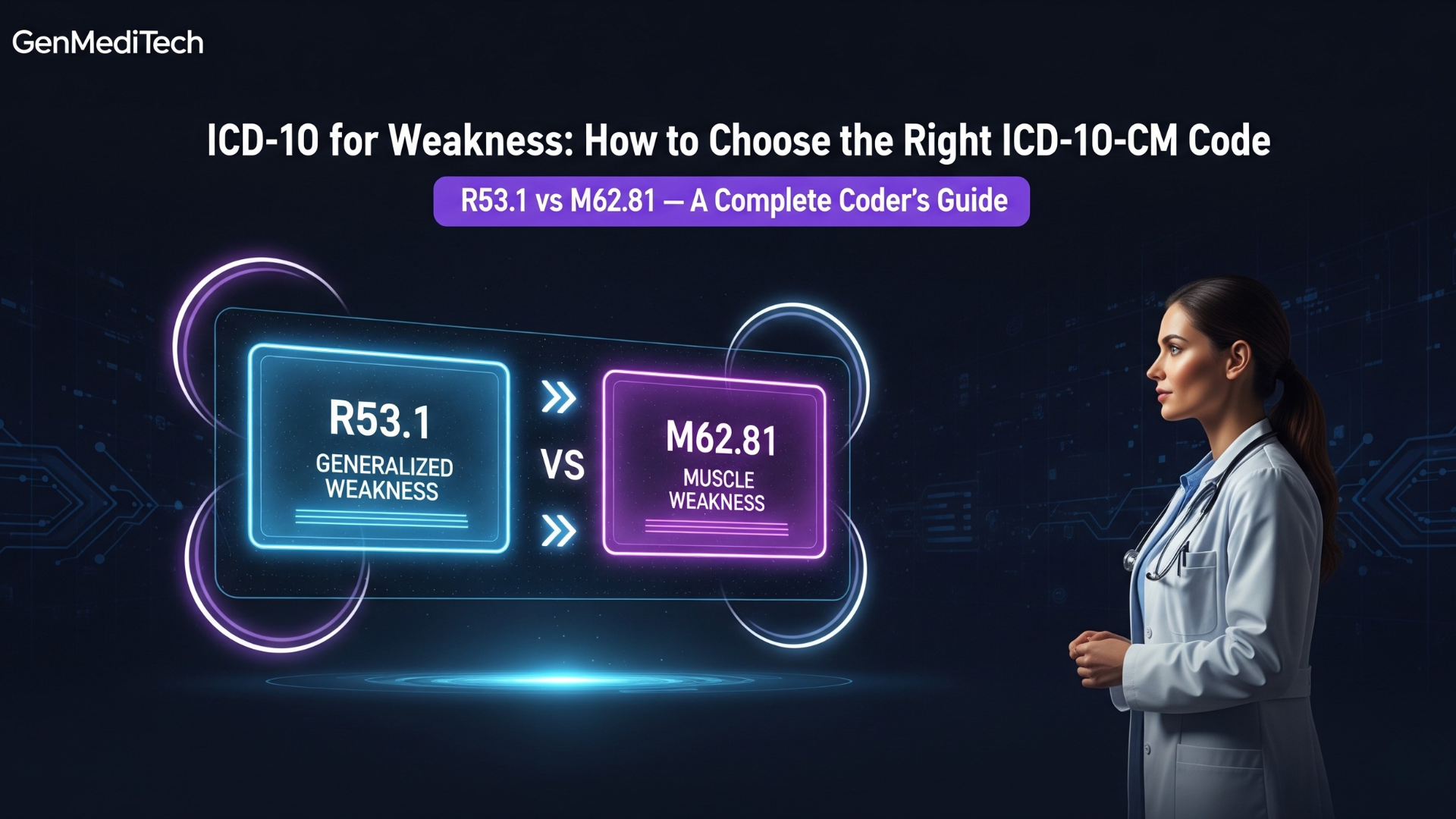
If you’re looking for the icd 10 code for weakness, this guide is built to help you code accurately, document cleanly, and reduce denials—without guesswork. In ICD-10-CM, weakness can be coded as a symptom (r53.1) or as generalized muscle weakness (m62.81), depending on what the provider actually documented.
The rule that decides everything (symptom vs confirmed diagnosis)
The FY 2026 ICD-10-CM Official Guidelines state that codes for signs and symptoms are acceptable for reporting purposes when a related definitive diagnosis has not been established (confirmed) by the provider. Once a definitive diagnosis is confirmed, coding should reflect that condition—and symptoms routinely associated with it generally are not coded separately unless instructed.
This is why blanket answers like “weakness always equals R53.1” underperform in real billing environments: the correct choice depends on documentation specificity, confirmed diagnoses, and whether the weakness is a symptom, a diagnosis, or part of another disease process.
Quick answer: What is the icd 10 code for weakness?
For many outpatient and therapy-related encounters, the symptom code r53.1 is commonly used when the provider documents “weakness” (including “Asthenia NOS”) and no definitive diagnosis has been confirmed yet.
However, if the provider documents generalized muscle weakness icd 10 as the condition, m62.81 may be the more accurate selection—and R53.1 explicitly excludes M62.81 via Excludes notes.
R53.1 deep dive (Weakness, Asthenia, and when it fits)
Use r53.1 when documentation supports weakness as a symptom and a definitive diagnosis has not been confirmed (or when the symptom is separately reportable under guideline rules). The code descriptor includes “Weakness” and “Asthenia NOS.”
Important Excludes logic: R53.1 excludes age-related weakness (R54), muscle weakness (generalized) (M62.81), sarcopenia (M62.84), and senile asthenia (R54). This matters because many denials occur when coders use R53.1 as a placeholder even though documentation supports a different condition.
Keyword matching notes (placed naturally):
- icd 10 for weakness often maps to R53.1 when documented as a symptom.
- asthenia icd 10 is captured under R53.1 as “Asthenia NOS.”
- general weakness icd 10 and gen weakness icd 10 frequently refer to the same “weakness symptom” coding intent—again, documentation decides.
M62.81 deep dive (How muscle weakness icd 10 code differs)
Use m62.81 when the provider documents “Muscle weakness (generalized)” as the condition being evaluated/treated—rather than a broad symptom of weakness.
M62.81 also has important Excludes notes, including an Excludes1 for muscle weakness in sarcopenia (M62.84) and Excludes2 for nontraumatic hematoma of muscle (M79.81).
Scenario A: “Leg weakness” searches
People search multiple variants, including bilateral leg weakness icd 10, icd 10 bilateral leg weakness, icd 10 code for leg weakness, and icd 10 code leg weakness. In most real-world documentation, you choose between:
- r53.1 when weakness is documented as a symptom (and no definitive diagnosis is confirmed), or
- m62.81 when generalized muscle weakness is documented as the condition.
If documentation points to a specific confirmed condition causing the weakness (for example, a neurologic or endocrine diagnosis), the symptom-code rule still applies: code selection must reflect confirmed diagnosis vs unconfirmed symptom per guidelines.
Include the abbreviations that appear in charts:
- le weakness icd 10 often refers to “lower extremity weakness” documentation intent.
- ble weakness icd 10 often refers to “bilateral lower extremity weakness” documentation intent.
In both cases, the same upstream decision applies: weakness symptom vs generalized muscle weakness vs confirmed underlying diagnosis.
Scenario B: “Arm weakness” searches
Users search : weakness of right arm icd 10, right arm weakness icd 10, and left upper extremity weakness icd 10. ICD-10-CM provides clear weakness coding examples for certain areas (e.g., facial droop via R29.810), but many limb-weakness searches require you to code based on provider documentation and, when available, the confirmed underlying cause.
If the provider has not confirmed an underlying diagnosis, weakness may be coded as a symptom (R53.1) under guideline rules; if generalized muscle weakness is documented, M62.81 may be used. If a definitive diagnosis is confirmed, code that diagnosis first and apply symptom-coding rules for whether additional symptom codes are appropriate.
ICD-10 Codes for Weakness – Complete Coding Reference Table
| ICD-10 Code | Condition Description | When to Use | Clinical Example |
|---|---|---|---|
| R53.1 | Weakness (general symptom) | Used when a provider documents general weakness without specifying muscle condition | Patient reports persistent fatigue and generalized weakness |
| M62.81 | Muscle Weakness (Generalized) | Used when muscle weakness is specifically documented | Patient diagnosed with muscle weakness affecting multiple muscle groups |
| R53.83 | Other Fatigue | When fatigue or exhaustion accompanies weakness | Chronic fatigue with mild weakness |
| G72.9 | Myopathy, unspecified | When weakness is linked to muscle disease | Muscle weakness due to suspected myopathy |
| G81.90 | Hemiplegia, unspecified side | Weakness affecting one side of the body | Stroke patient with left-sided weakness |
| R26.2 | Difficulty in Walking | When weakness leads to mobility issues | Elderly patient unable to walk due to lower extremity weakness |
Documentation checklist that supports clean claims
The FY 2026 guidelines stress that complete documentation is essential for accurate code assignment and that coders should review the entire record to determine the specific reason for the encounter and conditions treated.
For weakness-related encounters, a payer-friendly documentation checklist typically includes:
- whether weakness is subjective vs supported by objective findings (and the distribution: generalized vs focal),
- functional impact and onset/timeline,
- whether a definitive diagnosis has been established (confirmed) by the provider, and
- whether weakness is integral to a confirmed disease process or separately reportable under guideline logic.
Denial prevention notes (include NCCI correctly)
Even when your diagnosis coding is correct, denials can happen due to procedure-code bundling logic and payer edit rules. For Medicare, CMS updates the NCCI Policy Manual once per year and notes that the manual explains the rationale for NCCI edits.
Also, staying current matters across code sets: CDC/NCHS is responsible for the ICD-10-CM clinical modification in the U.S., the CPT Editorial Panel meets three times per year for CPT updates, and CMS explains HCPCS Level II covers products/supplies/services not included in CPT.
Conclusion
Accurate use of ICD-10 codes for weakness, such as R53.1 and M62.81, is essential for proper documentation, compliant billing, and timely reimbursements. At GenMeditech, our medical billing and coding experts help healthcare providers ensure precise coding and efficient revenue cycle management.
FAQs
1: What is the “weakness icd10” code?
Commonly, r53.1 is used when the provider documents weakness as a symptom and a definitive diagnosis has not been confirmed.
2: What is the icd 10 code for weakness in asthenia?
asthenia icd 10 is captured under r53.1 as “Asthenia NOS.”
3: What is the generalized muscle weakness icd 10 code?
m62.81 is the ICD-10-CM code for “Muscle weakness (generalized).”
4: Can I bill R53.1 if a definitive diagnosis is confirmed?
FY 2026 guidance says symptom codes are acceptable when a definitive diagnosis has not been established; if a definitive diagnosis is confirmed, coding should reflect that condition and symptom reporting follows the guideline rules.
5: Is there one single code for icd 10 code for leg weakness?
There are multiple coding pathways depending on documentation: weakness as a symptom (R53.1), generalized muscle weakness (M62.81), or a confirmed underlying diagnosis that should be coded according to guideline rules.