
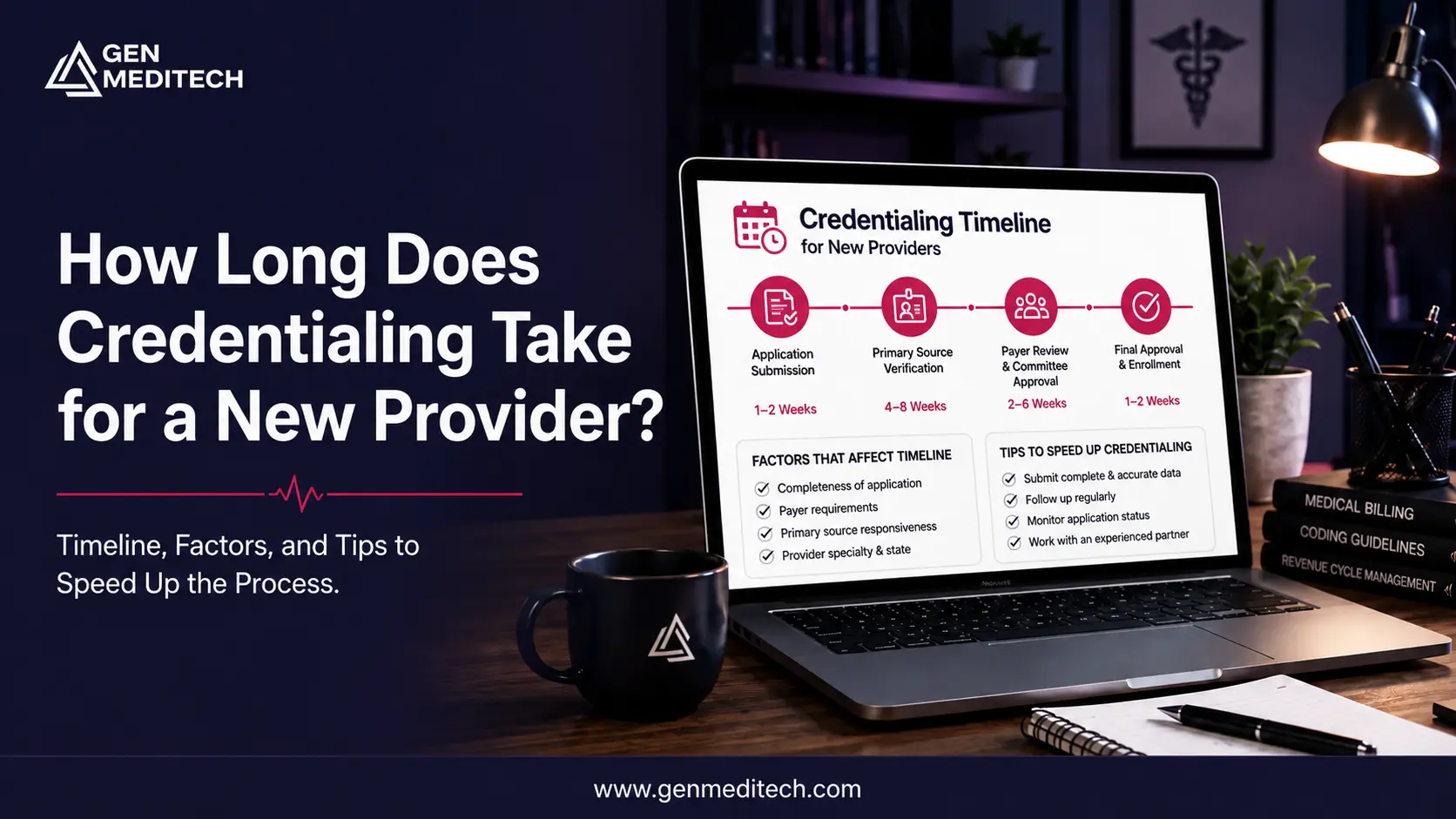
Most new providers complete credentialing in 90 to 120 days. Some payers finish it in as little as 45 days. Others stretch past 180 days when documents are incomplete or a specialty is complex. If you are simply asking how long does credentialing take, or more specifically how long does credentialing take for a new provider, the honest answer depends on which payer you are working with, how complete your paperwork is, and whether this is an initial application or a renewal.
This guide breaks the credentialing timeline down payer by payer, step by step, with the real numbers behind each stage. It also covers a detail most guides skip: being credentialed and being able to bill are not the same date.
What Is Provider Credentialing?
Provider credentialing is the process insurance companies, hospitals, and healthcare networks use to confirm a provider’s education, training, licensure, work history, and malpractice record before allowing that provider to treat patients under their network or facility.
The process relies on primary source verification. This means the payer does not just accept a copy of your diploma or license. It contacts your medical school, licensing board, and past employers directly to confirm everything on file is accurate.
How Does Provider Credentialing Work?
The process of credentialing follows the same basic path no matter which payer is involved, even though exact timeframes differ.
- The provider submits an application along with supporting documents.
- The payer or facility verifies each credential directly with the original source, such as the medical school, licensing board, or malpractice carrier.
- A credentialing committee reviews the verified file and votes to approve, deny, or request more information.
- Once approved, the provider signs a network contract and receives an effective date for billing.
This is the same structure whether the credentialing body is an insurance company, a hospital medical staff office, or a credentials verification organization working on a payer’s behalf.
How Long Does Credentialing Take, by Payer Type?
Every payer runs its own internal process, so the timeline is not the same across the board.
| Payer Type | Typical Timeline |
| Medicare (via PECOS) | 30 to 90 days in practice; individual Medicare Administrative Contractors publish faster internal processing goals for a clean electronic application, but the full timeline including NPI setup and any follow-up requests usually falls in this range |
| Medicaid | 45 to 120 days, depending on the state agency |
| Commercial insurance | 90 to 120 days, sometimes longer |
| Hospital privileging | 30 to 60 days, handled separately from payer credentialing |
How long does Medicare credentialing take?
Medicare enrollment through PECOS typically takes 30 to 90 days from submission to approval.
- Individual Medicare Administrative Contractors publish their own processing goals for a complete electronic application, ranging from about 15 to 45 days depending on the contractor, but that clock only starts once the application is fully complete.
- Real-world timelines run longer once NPI setup, identity verification, and any follow-up requests are factored in.
- Missing documentation can add 30 days or more, and the process pauses entirely if a file goes to a fraud or integrity review.
How long does Medicaid credentialing take?
Medicaid credentialing timelines vary the most of any payer type, since each state runs its own agency with its own rules and staffing. A clean application might clear in six weeks in one state and four months in another with a backlog. Always check the specific state Medicaid portal rather than relying on a national average.
How long does commercial insurance credentialing take?
Commercial payers such as Aetna, Cigna, UnitedHealthcare, and Blue Cross Blue Shield plans generally take 90 to 120 days. This covers primary source verification, an internal compliance review, and a final vote from the credentialing committee, which usually meets only monthly or quarterly.
How long does hospital credentialing take?
Hospital credentialing, also called hospital privileging, runs on a separate track from insurance credentialing and typically takes 30 to 60 days. It focuses on clinical competence and hospital-specific requirements, such as peer references and department chair approval, rather than payer enrollment rules. A provider can hold hospital privileges and still be waiting on separate payer credentialing before billing insurance for services at that hospital.
A real payer example
Oscar Health, a licensed health insurance company, states on its own site that its credentialing process for new providers takes up to 45 days once it receives all required applications and documents. This is useful because it comes directly from a payer rather than from an estimate, and it shows that a fast, well-run credentialing operation is possible on the shorter end of the range.
Initial Credentialing vs. Re-credentialing
Initial credentialing, the process for a brand-new provider joining a network, typically takes the full 90 to 150 days because there is no existing file to update.
Re-credentialing, which happens on a set cycle for providers already in a network, usually moves faster since much of the provider’s history is already verified. Most health plans that follow NCQA guidelines re-credential providers roughly every 36 months, and the process should start 90 to 120 days before the current cycle expires to avoid a gap in network status.
What Documents Are Required for Credentialing?
Every payer asks for a similar core set of documents. Having these ready before starting the application is the single biggest factor in avoiding delays.
- Completed application with personal and professional details
- Proof of education, including diplomas and residency certificates
- Active state medical license and board certifications
- Detailed work history with no unexplained gaps
- Proof of current malpractice insurance
- Professional references
- DEA registration, if the provider prescribes controlled substances
- Government-issued identification
- Authorization for a background check
One detail trips up more applications than it should: list the month and year for each position, not just the year. NCQA-aligned payers treat a gap of six months or more as unexplained unless it is documented, and a work history with only years listed often reads as a gap even when there is none.
Step-by-Step Credentialing Timeline
| Step | Typical Time | What Happens |
| Document preparation | 1 to 2 weeks | Gathering licenses, diplomas, references, and insurance proof |
| CAQH profile setup and attestation | 1 to 3 days once documents are ready | Entering and attesting information in the CAQH provider profile, still most commonly called CAQH ProView though CAQH also refers to it as the Provider Data Portal, which most commercial payers require to be complete and authorized before they will begin any credentialing review at all |
| Application submission | 1 to 2 weeks | Completing and submitting payer-specific forms |
| Primary source verification | 4 to 6 weeks | Payer contacts schools, boards, and employers directly |
| Payer internal review | 4 to 8 weeks | Compliance and background checks against payer standards |
| Committee review and decision | 1 to 4 weeks | Credentialing committee votes, meeting only monthly or quarterly |
| Contracting and effective date | 2 to 4 weeks | Signing the payer contract and setting the network start date |
The committee review step is worth flagging on its own. Even a perfect application has to wait for the next scheduled committee meeting. If a file becomes ready the day after a meeting, it may sit for several weeks until the next one.
For commercial insurance specifically, the CAQH step is a gatekeeper, not a formality. Most commercial payers will not start meaningful review until the provider’s CAQH profile clears three conditions:
- The profile is fully complete, with no missing sections
- It has been attested, and reattested every 120 days even if nothing changed
- It is explicitly authorized for that specific payer to access
Missing any one of these stalls the file before verification even begins, regardless of how complete the rest of the application is.
Credentialed vs. Enrolled vs. Able to Bill
This is the part most guides leave out, and it is where practices lose real revenue.
Being approved by a credentialing committee does not mean a provider can bill that payer yet. There are usually three separate milestones:
- Credentialed: the payer has verified the provider’s qualifications and approved them.
- Enrolled: the provider has signed a contract and been loaded into the payer’s system.
- Effective date: the actual date from which the payer will pay claims for that provider.
A provider can be fully credentialed and still be weeks away from an effective date. Billing a claim before the effective date usually results in a denial, even though the provider is technically approved. Practices should always confirm the effective date in writing rather than assuming approval means they can start billing immediately.
Why Does Credentialing Take So Long?
Delays come from three different directions, and only one of them is within a provider’s control.
Provider-side factors
- Incomplete or inconsistent application details
- Unexplained gaps in work history, including years listed without months
- Licensing in multiple states
- Slow response to requests for more information
Payer-side factors
- Credentialing committees that meet only monthly or quarterly
- High application volume creating backlogs
- Different requirements across payers with no shared standard
- Internal staffing shortages
External factors
- Slow responses from medical schools or licensing boards
- State-specific Medicaid rules and staffing levels
- Seasonal slowdowns around holidays
How GenMediTech Reduces Credentialing Delays?
Most credentialing delays come from the provider side, incomplete applications, expired CAQH attestations, and missed follow-ups. These are the exact problems a dedicated credentialing team eliminates.
GenMediTech’s credentialing specialists:
- Build and maintain the CAQH ProView profile from day one so it is complete, attested, and authorized before any payer pulls it
- Submit applications to multiple payers in parallel, not one at a time
- Track every submission with a reference number and follow up within one week if there is no acknowledgment
- Maintain direct contacts at each payer’s credentialing department, not just a general inbox
- Catch work history gaps, missing months, and document inconsistencies before they stall the file
- Confirm the actual billing effective date in writing so the practice never bills before the payer is ready
The result is a credentialing process that moves as fast as the payer allows, without losing time to the avoidable delays that are entirely within your control.
Credentialing Timelines for Special Provider Situations
Not every provider follows the standard timeline. A few situations move faster or slower than average.
Locum tenens providers Facilities often expedite temporary privileges for locum tenens providers, sometimes completing this step in 30 to 60 days since the arrangement is short-term.
Telemedicine and multi-state providers Providers who see patients across state lines usually need active licensure in each state, and some payers require separate credentialing per state. This adds time compared with a single-location provider.
New graduates have a shorter work history to verify, which can speed up one part of the process, but payers may apply extra scrutiny since there is less track record to review.
International medical graduates Verifying foreign medical education and training takes longer because it involves contacting institutions outside the standard U.S. verification networks, and some payers require additional documentation such as ECFMG certification.
2026 Update: NCQA Tightened Its Verification Window
As of July 1, 2025, NCQA shortened its primary source verification window to 120 calendar days for files processed by NCQA-accredited organizations or their delegates, replacing the longer limit that applied before. Files processed before that date are still scored under the prior requirement.
This does not guarantee a faster personal timeline, since a payer can still take the full window, but it puts a firmer ceiling on how long verification can legally drag on for accredited organizations.
How to Estimate Your Own Credentialing Timeline
A generic range is only a starting point. To estimate a realistic date, answer three questions:
- Which payers am I applying to? Medicare and a single commercial plan move faster than five commercial payers at once.
- Is this initial credentialing or re-credentialing? Re-credentialing is usually faster since a file already exists.
- Am I credentialing in one state or several? Multi-state credentialing adds time for each additional license and jurisdiction involved.
Add the document preparation time, the slowest payer’s typical range from the table above, and a buffer of two to four weeks for committee scheduling. That total is a far more realistic start date than a single national average.
How to Speed Up the Credentialing Process
- Start the process four to six months before the intended patient start date
- Keep the CAQH ProView profile complete and currently attested, since an expired attestation stalls every connected payer at once
- Use a document checklist so nothing is missing on first submission
- Submit applications to multiple payers in parallel rather than one at a time
- Track every submission with a reference number and follow up within a week if there is no acknowledgment
- Build a direct contact at each payer’s credentialing department rather than relying only on a general inbox
- Consider working with physician credentialing services if managing multiple payers in-house is stretching staff too thin, since a dedicated team already knows each payer’s quirks and follow-up cadence
Re-credentialing: The Clock Does Not Stop After Initial Approval
Initial approval is not the end of the credentialing relationship. Most NCQA-aligned payers require re-credentialing on a set cycle, generally every 36 months, and providers should begin that renewal 90 to 120 days ahead of the expiration date. A lapsed attestation or an expired license sitting in a CAQH profile can pause claims processing even for a provider who has been in-network for years, so ongoing maintenance matters just as much as the initial application.
Conclusion
Credentialing for a new provider typically takes 90 to 120 days, faster for Medicare, slower for commercial insurance. The fastest way to protect that timeline is to start early, keep CAQH current, and confirm the actual billing effective date before submitting any claims.
Practices juggling multiple payers, multiple states, or a growing provider roster consistently lose weeks to small, avoidable errors, an expired attestation, a missing month in the work history, a follow-up that never happened.
GenMediTech’s medical credentialing team handles these details so your practice does not absorb the cost of a delayed start date. Whether you are credentialing a single new provider or managing ongoing enrollment across a multi-specialty group, a dedicated team that knows each payer’s requirements and follow-up cadence moves the process faster than in-house management on top of an already full workload.
Frequently Asked Questions
Can a provider see patients before credentialing is complete?
A provider can often see patients before credentialing finishes, but the practice usually cannot bill insurance for those visits until the provider is credentialed and the payer sets an effective date. Seeing patients without an approved billing pathway means the practice absorbs the cost or bills the patient directly until enrollment is complete.
What is the fastest a provider can realistically get credentialed?
The fastest realistic timeline is around 45 days, and only with a single payer, a complete application on day one, and no committee scheduling delays. Oscar Health, for example, states its own credentialing process takes up to 45 days once all documents are received.
Does CAQH speed up or slow down credentialing?
CAQH ProView speeds up credentialing when the profile is complete and attested, since most commercial payers pull directly from it instead of requiring a separate application. An incomplete or expired CAQH profile slows down every payer connected to that provider at once.
How is re-credentialing different from initial credentialing?
Re-credentialing is usually faster than initial credentialing because the payer already has a verified file on the provider. Most NCQA-aligned payers require re-credentialing every 36 months, and the process should start 90 to 120 days before the current cycle expires.
Can outsourcing credentialing actually shorten the timeline?
Outsourcing credentialing does not change a payer’s internal processing time, but it reduces the delays caused by incomplete applications, missed follow-ups, and expired CAQH attestations, which are the most common reasons credentialing takes longer than the payer’s own stated timeline.
How long does it take to get a credentialing certification?
This depends on what “certification” means in context. If it refers to an organization earning NCQA Credentialing Certification, meaning a health plan or credentials verification organization becomes formally certified by NCQA, the typical evaluation timeframe from application submission to decision is about 12 months, according to NCQA’s own FAQ page. If it refers to an individual provider’s own board certification, that timeline depends entirely on the certifying board and is separate from payer credentialing altogether.
What is the process of credentialing?
The process of credentialing has four core stages: submitting an application with supporting documents, primary source verification of every credential, review and a vote by a credentialing committee, and finally contracting with an effective date for billing. Every payer and facility follows this same basic structure even though the exact timeframes differ.
How often does provider re-credentialing occur?
Provider re-credentialing typically occurs every 36 months under NCQA-aligned standards. Some individual payers or state Medicaid programs may set a shorter cycle, so providers should confirm the exact interval with each payer rather than assuming every plan follows the same 36 month schedule.
How does provider credentialing work?
Provider credentialing works by having a payer or facility verify a provider’s education, licensure, work history, and malpractice record directly with the original source rather than accepting self-reported information. Once verification is complete, a credentialing committee reviews the file and approves the provider to join the network or medical staff, followed by a contract and a billing effective date.
References
- NCQA, Credentialing Accreditation Standards: https://www.ncqa.org/programs/health-plans/credentialing/
- NCQA, 2025 Credentialing and Provider Network Standards Policy Updates: https://wpcdn.ncqa.org/www-prod/2025-CRPN-Policy-Updates_11-17-25.pdf
- CMS, Medicare Enrollment Applications: https://www.cms.gov/medicare/enrollment-renewal/providers-suppliers/chain-ownership-system-pecos/enrollment-applications
- CMS, Medicare Provider Enrollment (MLN9658742): https://www.cms.gov/Outreach-and-Education/Medicare-Learning-Network-MLN/MLNProducts/EnrollmentResources/provider-resources/provider-enrolment/Med-Prov-Enroll-MLN9658742.html
- National Government Services, Provider Enrollment Application Process Timeline: https://www.ngsmedicare.com/web/ngs/hot-topics2?selectedArticleId=1450024
- Oscar Health, How Long Does Credentialing Take for a New Provider Entering the Network: https://www.hioscar.com/faq/how-long-does-credentialing-take-for-a-new-provider-entering-the-network