
Intro: Gastroesophageal reflux disease (GERD) is a long-term condition that causes stomach acid to flow back into the esophagus. This can cause symptoms like heartburn, regurgitation, and chest pain. ICD-10-CM code K21 (Diseases of the esophagus) is the category for GERD. For proper clinical documentation and payment, it is important to code GERD correctly.. Gen Meditech is providing a complete guide for all GERD-related ICD-10-CM codes (such as K21. 9 ICD-10, K21. 0, K21. 01, etc.), explains how to use them, and gives coding advice so that you can get it right.
Introduction to GERD
Gastroesophageal reflux disease (GERD) is a very common digestive problem. It happens because the lower esophageal sphincter, which is the ring of muscle that stops stomach acid from flowing back up, is weak or too relaxed. People who have heartburn, regurgitation, a chronic cough, and chest pain are more likely to have problems with their esophageal lining. If you don’t treat GERD, it can lead to problems like esophagitis, strictures, and Barrett’s esophagus, which can all lead to cancer. The ICD-10-CM code range K21 says that GERD is a disease of the digestive system. Nurses and doctors play a big role in managing GERD, from teaching patients about it to treating it. Accurate coding is also very important so that the condition is well documented for billing and treatment planning.
Overview of GERD ICD-10 Codes
The main ICD-10-CM codes for GERD are in the K21 category. These include: + HIS gastroesophageal (GE reflux disease with or without esophagitis and related issues. These are the important codes and when to use them.
| Code | Description | When to Use |
| K21.9 | GERD without esophagitis | Use when GERD is diagnosed without any evidence of esophageal inflammation |
| K21.0 | GERD with esophagitis, without bleeding | Use when endoscopy confirms esophagitis (inflammation), no esophageal bleed |
| K21.01 | GERD with esophagitis, with bleeding | Use when GERD causes esophagitis and documented bleeding (e.g. ulcer) |
| K21.1 | GERD with esophageal stricture | Use if GERD has led to a narrowing (stricture) of the esophagus |
| K21.8 | Other specified GERD | Rarely used; for non-specific GERD not otherwise classified |
| R12 | Heartburn (Gastric esophageal reflux) | Use when only symptom of heartburn is documented (no confirmed GERD) |
| Z87.19 | Personal history of other diseases of digestive system (e.g. GERD) | Use if patient has past history of GERD (no current symptoms) |
- K21.9 – GERD without esophagitis: This is the most common GERD code. When a patient has reflux symptoms but no signs of inflammation in the mucosa, this applies. It catches classic GERD without any problems.
- Use code K21.0 when an exam or endoscopy shows erosive esophagitis from acid reflux but no bleeding. For instance, there are linear erosions or ulcers, but no bleeding.
- K21.01 – GERD with esophagitis, with bleeding: Select this when GERD causes esophagitis and there is documented bleeding (e.g. GI bleed, ulcer). This requires explicit mention of bleeding or “with hemorrhage.” (ICD-10-CM includes a specific 5th digit for bleeding).
- K21.1 – GERD with esophageal stricture: Use if GERD has caused scarring and a stricture. Note this code implies both reflux and stricture.
- K21.8 – Other GERD: Rarely used catch-all when GERD is diagnosed but doesn’t fit above. (Usually coders use K21.9 or K21.0 instead).
- R12 – Heartburn: Code this only if patient reports heartburn but GERD is not confirmed or documented. It captures the symptom rather than the disease.
- Z87.19 – History of GERD: When a patient has a past history of GERD (e.g. remote surgery) but is not currently symptomatic, use this “personal history” code.
These ICD-10 codes correlate with clinical diagnosis codes. For example, “GERD with esophagitis” must be recorded by endoscopy or biopsy; otherwise, you should assume the code for K21. 9. Remember that ICD-10-CM requires specificity. Official Sources GERD is listed under K21 (Diseases of the esophagus) and states that newborn reflux (P78. 83) is excluded. The aforementioned table catalogs the description and use case of each code.
Definitions and Differences in Clinical Settings
When acidic stomach contents flow back into the esophagus on a regular basis, this is called GERD. Esophagitis (K21.9) is not present, so the lining of the esophagus is irritated but not visibly inflamed. Heartburn, regurgitation, and a cough that won’t go away are some of the symptoms. Endoscopy shows erosion or inflammation of the esophagus in people with esophagitis (K21.0/K21.01). Esophagitis leads to intensified pain, dysphagia (difficulty swallowing), and an elevated risk of hemorrhage. Use K21.01 if there is inflammation with bleeding, such as an ulcer or hematemesis.
Key differences:
- K21.9 (GERD w/o esophagitis): This is the mildest form; there is no visible damage to the mucosa. The patient may exhibit standard reflux symptoms, yet endoscopy results are normal or inconclusive.
- K21.0 (GERD with esophagitis, no bleeding): There is acid damage (erythema, erosions), but there is no bleeding. Patients frequently exhibit exacerbated symptoms and may necessitate escalated therapeutic dosages.
- K21.01 (GERD with esophagitis and bleeding): There is bleeding that is still going on or has just happened. This could mean GERD ulcers or erosions that bleed.
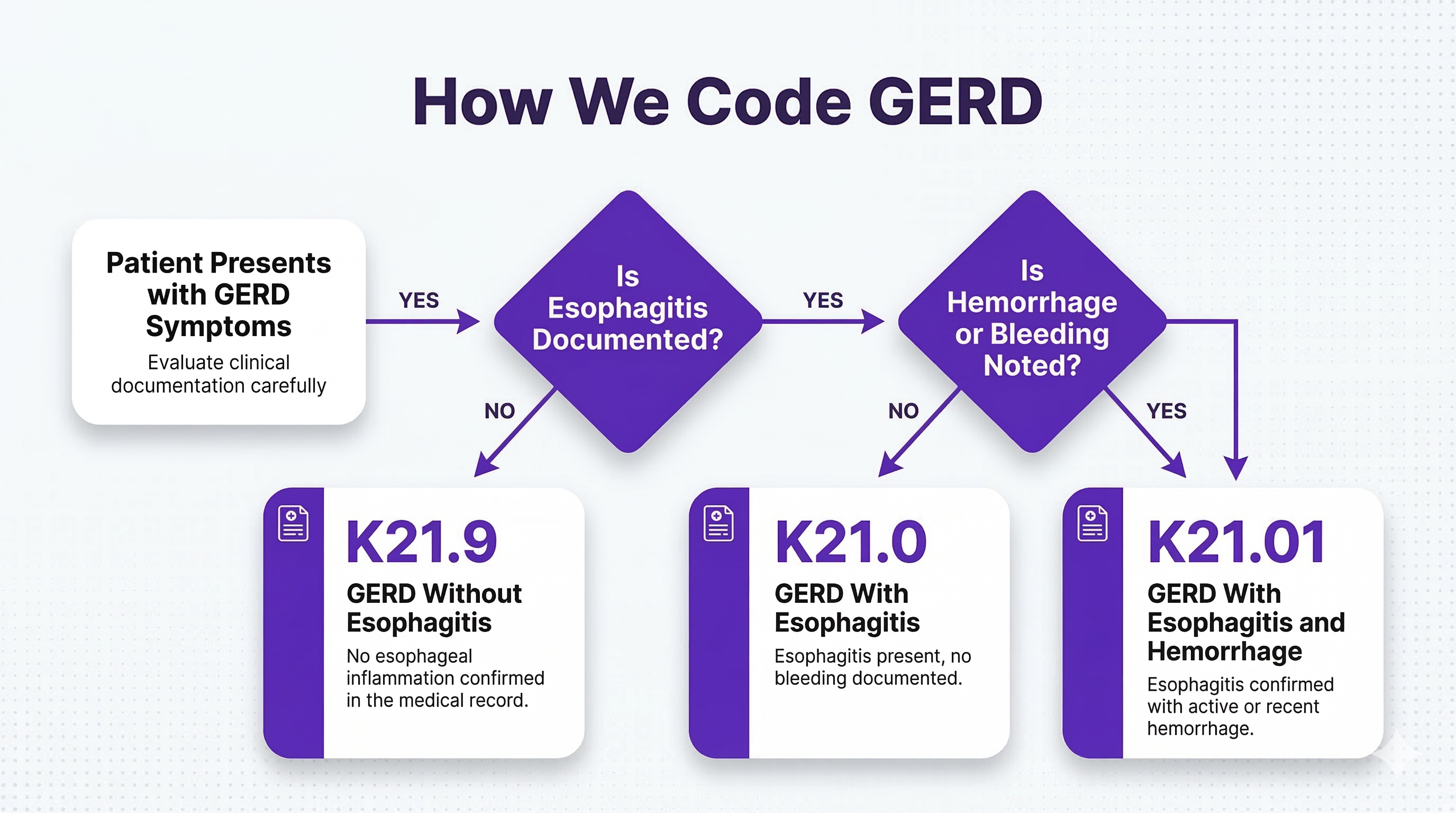
A quick way to remember: K21.9 means GERD without esophagitis, K21.0 means GERD with esophagitis (but no bleeding), and K21.01 means GERD with esophagitis and bleeding.
Official Coding Guidelines for GERD ICD-10 Codes
The ICD-10-CM Official Guidelines provide important rules for coding GERD. First, GERD is treated as a confirmed diagnosis only when clearly documented. In outpatient settings, if GERD is only a “rule-out” or suspected, coders may instead code the patient’s symptoms (e.g. heartburn R12) until a diagnosis is confirmed. In inpatient care, an uncertain GERD diagnosis can be coded as if confirmed. Additionally, ICD-10-CM Excludes1 notes specify that newborn esophageal reflux is coded separately (P78.83) and should not be used with K21.
No other Chapter-specific notes apply to GERD beyond these guidelines. The upshot: ensure GERD is documented as an active condition. If only chronic heartburn or reflux is documented without esophagitis, use K21.9. If documentation is unclear whether esophagitis is present, query the provider. These guidelines help prevent miscoding. For example, suspected GERD in an outpatient cannot be coded as GERD. Citing authoritative sources can guide these decisions, such as the ICD-10-CM Official Guidelines and AAPC coding resources.
When to Use Each GERD ICD-10 Codes
K21.9 – GERD without Esophagitis
Use K21.9 only when the patient has classic reflux symptoms and no evidence of esophagitis. Documented findings should support absence of inflammation (e.g. a normal EGD report). For instance:
- Patient with chronic heartburn whose endoscopy is normal.
- Coder note: Confirm the record does not mention esophageal inflammation or ulcers. If nothing is noted, K21.9 is appropriate.
K21.0 – GERD with Esophagitis (no bleeding)
Select K21.0 if the patient’s GERD has led to visible esophageal inflammation without hemorrhage. Typically this is an EGD finding (e.g. erosive esophagitis, ulcers) but explicitly states “no active bleeding.” Examples:
- EGD shows grade A esophagitis, no bleeding ulcers.
- Implication: The provider explicitly documented esophagitis from GERD. If there is any ambiguity, query for clarification.
K21.01 – GERD with Esophagitis and Bleeding
Use K21.01 when there is esophagitis with documented bleeding. Clues include terms like “erosive ulcer with hemorrhage” or “GI bleed from reflux ulcer.” This code is less common but crucial for accuracy:
- Example: Endoscopy identifies an esophageal ulcer with oozing blood.
- Remember to code any related GI bleed symptoms if separate (e.g. melena may co-occur).
K21.1 – GERD with Esophageal Stricture
Code K21.1 if GERD has progressed to cause an esophageal stricture or narrowing. This implies chronic, severe GERD. Use only if stricture is explicitly documented (e.g. “peptic stricture from reflux”). If stricture is present, both reflux and stricture can be coded.
R12 – Heartburn (Esophageal Reflux Symptom)
If a patient has only reflux symptoms like heartburn, but GERD is not diagnosed, use R12. This captures the symptom (“heartburn”) rather than disease. If later GERD is confirmed, switch to K21.x as above.
The decision process can be visualized as a flowchart:
Coding Scenarios & Examples
- Typical GERD (K21.9): Patient complains of daily heartburn. EGD is normal. Code: K21.9 (GERD without esophagitis). No bleed or ulcers are documented.
- GERD with Erosive Esophagitis (K21.0): Patient has reflux and dysphagia. Endoscopy shows linear esophageal ulcers (no bleeding). Code: K21.0 (GERD with esophagitis, no hemorrhage). Document esophagitis findings in the note.
- GERD with Bleeding (K21.01): Patient has known GERD with melena. Endoscopy finds bleeding reflux ulcers. Code: K21.01 (GERD with esophagitis and hemorrhage). If hematemesis is present, also code R04.5 (hematemesis).
- Stricture (K21.1 plus K22.4): Severe GERD patient has peptic stricture. Codes: K21.1 (GERD with stricture) and K22.4 (esophageal stricture). Use both to capture disease and complication.
Each scenario illustrates the importance of documentation. Always match the code to the most severe confirmed condition: bleeding > esophagitis > reflux.
Documentation and Clinical Considerations
Thorough documentation is critical for GERD coding. Key elements to record include:
- Evidence of Esophagitis: Biopsy or endoscopic findings (e.g. erosions, ulcer, Barrett’s changes). State “esophagitis” explicitly for K21.0/01.
- Bleeding: Note any hemorrhage (hematemesis, melena, bleeding ulcer). This triggers K21.01 if present.
- Heartburn/Reflux: Even if esophagitis is absent, document symptom severity and trigger factors (justifies K21.9).
- Associated Findings: Note hiatal hernia, esophageal stricture, Barrett’s esophagus – see next section.
- Los Angeles Classification: If EGD performed, record the LA Grade of esophagitis (A–D) to support K21.0.
Pitfalls: Never code K21.9 if any esophagitis is documented. If the chart mentions “erosive gastritis” or “esophagitis,” query the physician. Also, do not default to K21.9 just because esophagitis is not documented; absence of mention should be explicitly stated in report. According to coding specialists, “K21.9 is only valid when clearly supported by documentation”.
Common Comorbidities & Differential Diagnoses
Patients with GERD often have related conditions. Common comorbidities and their ICD codes include:
- Hiatal (Diaphragmatic) Hernia: Can cause reflux; code K44.9 for diaphragmatic hernia without obstruction.
- Obesity: Increases reflux; code E66.x (if relevant).
- Pregnancy: Hormonal reflux; code O26.6 if in prenatal setting.
- Asthma/Chronic Cough: Acid reflux can mimic or worsen respiratory symptoms; code J45.x as appropriate (GERD can exacerbate these).
Important differential/related codes:
- Barrett’s Esophagus: A columnar metaplasia due to chronic GERD. Use K22.70 (no dysplasia) or K22.71 (with dysplasia). Barrett’s is not coded as GERD – it has its own code (see table below).
- Esophageal Stricture: Use K22.4 for peptic stricture (often from long-standing GERD).
- Ulcer of Esophagus: K22.10 for esophageal ulcer without hemorrhage (if not captured by K21.01 coding).
- Hiatal Hernia: K44.9 if noted as cause of reflux.
| Related Condition | ICD-10 Code | Notes |
| Barrett’s esophagus (no dysplasia) | K22.70 | Due to chronic GERD; separate diagnosis |
| Barrett’s esophagus (dysplasia) | K22.71 | Precancerous change in Barrett’s esophagus |
| Esophageal stricture (peptic) | K22.4 | Often from GERD scarring; report along with K21.x |
| Hiatal hernia | K44.9 | If hernia is noted with reflux |
| Esophageal ulcer (no bleed) | K22.10 | Ulceration due to reflux without hemorrhage |
| Personal history of GERD | Z87.19 | If patient had GERD in past but now resolved |
Note: GERD and these conditions should not be coded together if one is the sequela of the other. For example, if a stricture was caused by GERD= K21. 1 replaces a generic K22. 4 for esophagitis; however, you would continue to code both K21. 1 and K22. 4 when indicated. Code always for the underlying disease (GERD) as well as the all manifestations of the disease that you find in your documentation.
Crosswalk to CPT/Procedure Codes
Common procedures for GERD diagnosis or treatment include:
- Esophagogastroduodenoscopy (EGD): CPT 43235–43259 (e.g. 43235 = diagnostic EGD without biopsy). Often done to visualize esophagitis or Barrett’s.
- pH Monitoring: CPT 91034–91039 (esophageal pH study) if offered. Confirms acid reflux events.
- Esophageal Manometry: CPT 91010 (manometry) to assess LES function in refractory cases.
- Fundoplication (surgery): CPT 43280–43284 (laparoscopic fundoplication). This is a treatment procedure for severe GERD.
- Anesthesia for Endoscopy: CPT 00740 (anesthesia for esophagoscopy) – remember to apply QX modifier if no anesthesiologist (per some payers).
Tip: Always check bundling edits. For example, an EGD and manometry on same day may have specific payer rules. Use medical necessity to justify each procedure.
Billing, Reimbursement, & Audit Tips
- Billability: All K21 codes (K21.9, K21.0, K21.01) are valid, billable ICD-10-CM codes for GERD-related visits. They are covered by Medicare and commercial insurers for GERD treatment.
- Denial Risk: The most common coding error is choosing K21.9 when esophagitis is present. Auditors frequently flag charts where endoscopy showed erosions but the claim used K21.9. Always match code to documentation. Conversely, don’t upcode to K21.0 if esophagitis isn’t documented.
- Medical Necessity: Document GERD symptoms and complications clearly to justify procedures. For example, an EGD needs a diagnosis code showing indication (e.g. “chronic GERD with dysphagia”), not just K21.9 alone.
- Value-Based Care: GERD is not a CMS HCC (Hierarchical Condition Category) for risk adjustment. However, accurate coding still matters for quality reporting.
- Local Coverage Determination: Check if your payer has any specific rules (LCDs) for GERD. Some payers require documentation of failed medical therapy before approving surgery codes.
By following these tips and auditing your GERD coding (e.g. K21.9 only when appropriate), you can minimize denials and ensure proper reimbursement.
Patient-Facing Explanation (Layman’s Terms)
GERD (often called acid reflux) has specific ICD-10 codes. In simple terms, K21.9 is the code for “GERD without inflammation,” meaning you have reflux but the esophagus lining looks normal. K21.0 is “GERD with inflammation,” used when acid has caused esophagitis (often diagnosed by endoscopy). If bleeding is present, that becomes K21.01. For example, if you just have heartburn but no damage, the code is K21.9. If you have ulcers or erosions in the esophagus from GERD, it’s K21.0. This coding helps doctors and insurers communicate about your condition and treatment needs. (For more info, see the World Health Organization’s ICD-10 book or the CDC’s GERD overview.)
Frequently Asked Questions (FAQs)
What is the ICD-10 code for GERD?
The main codes are K21.9 (GERD without esophagitis) and K21.0 (GERD with esophagitis). Use K21.9 if no inflammation is documented, and K21.0 if esophagitis is confirmed.
How do I know if GERD has esophagitis?
Esophagitis is usually confirmed via endoscopy. If the doctor reports erosions or ulcers in the esophagus, that’s esophagitis. Otherwise, GERD is coded as K21.9.
Is an endoscopy required to code GERD?
Not always. If the doctor is confident in GERD diagnosis from symptoms and treatment history, you can code K21.9 without an endoscopy. But to code K21.0 or K21.01, you generally need objective evidence from endoscopy or biopsy.
What if only heartburn is documented?
If the note only mentions “heartburn” or “acid reflux” with no GERD diagnosis, use R12 (heartburn). If the provider confirms GERD in the plan, use K21.x as appropriate.
What is the ICD-9 code for GERD?
In ICD-9-CM (no longer used in the US), GERD was coded 530.81. (“Esophageal reflux” had code 530.81 for GERD.) The ICD-9 code for heartburn was 787.1 (ICD-9 code for acid reflux).
Is there a code for GERD with esophagitis without bleeding?
Yes. K21.0 is “GERD with esophagitis without hemorrhage.” (If there was bleeding, it would be K21.01.)
What about unspecified GERD?
ICD-10-CM does not have a separate “unspecified” GERD code beyond K21.9. K21.9 is used when GERD is diagnosed but no esophagitis is noted, effectively “GERD unspecified.”