
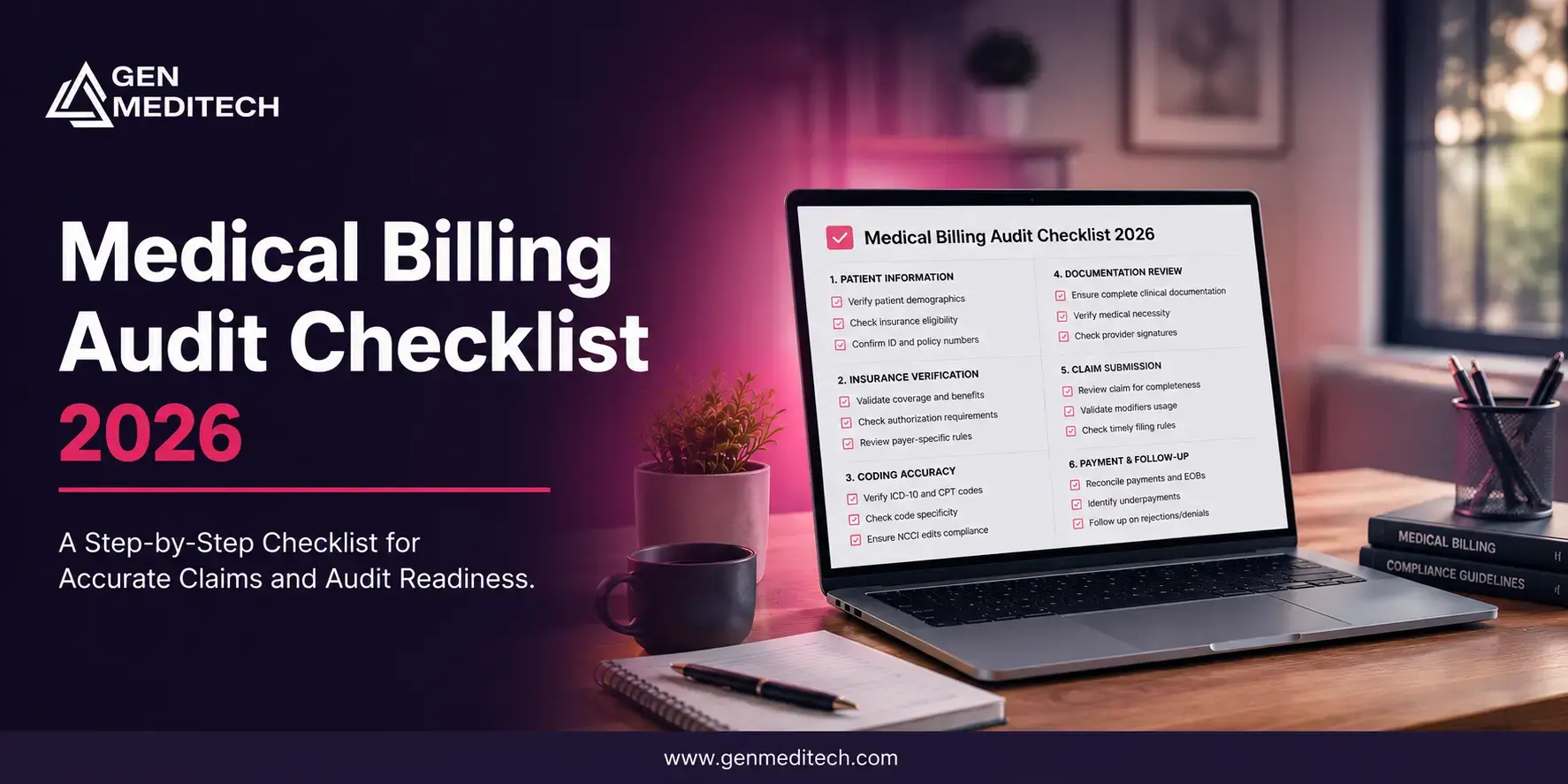
Most practices do not lose money all at once. It builds slowly, one denied claim, one underpaid EOB, one missed charge capture. None of it feels critical at the moment. All of it adds up to thousands in revenue lost every single month.
In 2026, median revenue leakage for multi-specialty practices sits between $70,000 and $400,000 annually, not from fraud, but from billing gaps nobody audited. That is exactly why a structured medical billing audit checklist matters. It helps practices catch billing errors early, improve the revenue cycle, reduce denials, and recover money that would otherwise slip through unnoticed.
This guide breaks down the complete medical billing audit process, step by step, so healthcare practices can audit smarter, strengthen compliance, and improve financial performance without operating on assumptions.
What Is a Medical Billing Audit and What It Actually Covers?
A medical billing audit is a systematic review of a practice’s entire billing and revenue cycle, from the moment a patient checks in to the day a payment is posted (or written off). It checks whether claims are accurate, compliant with payer rules, and coded to reflect the actual care delivered.
It is not just a coding review. A medical coding compliance check is one part of the process. A full medical billing audit services review looks at documentation, charge capture, claim submission, payment reconciliation, and denial patterns, all of it.
This distinction matters before choosing a checklist. A coding-only audit fixes codes. A full revenue cycle management audit fixes the system.
Why 2026 Changed the Audit Game for Every Practice?
Here is what most billing guides skip.
Payers are no longer waiting for bad claims to be submitted. AI-driven claim scrubbers now flag risky billing patterns before a human even reviews the file. High modifier-25 usage, repeated 99215 billing, and documentation that does not match MDM complexity are now automatic red flags, not just audit risks.
At the same time:
- National claim denial rates hit 12% in 2026 (CMS data)
- RAC (Recovery Audit Contractors) recovered $474 million in the most recent reporting cycle
The practices getting hurt are not the ones with fraud problems. They are the ones with no system, no checklist, no frequency, no corrective follow-up. That is the gap this article closes.
4 Types of Medical Billing Audits (Pick the Right One First)
Not every audit has the same goal. Understanding the type determines what gets reviewed and when.
- Internal Audit: Done by the in-house billing team. Best for routine quality control, staff training, and early error detection. Run it monthly.
- External Audit: Done by a third-party RCM or compliance specialist. Gives an unbiased view of patterns the internal team may have normalized. Run it annually, or before any payer contract renegotiation.
- Prospective Audit: Happens before claim submission. Catches coding and documentation errors at the source, preventing denials before they happen.
- Retrospective Audit: Happens after payment is posted. Best for underpayment recovery in medical billing and identifying patterns in payer behavior that cost money over time.
The most effective practices combine all four, internal audits monthly, external annually, and prospective/retrospective built into the workflow as ongoing processes.
The Medical Billing Audit Checklist: Step-by-Step Revenue Cycle Flow
This is not a random list of tasks. It follows the revenue cycle in the exact order billing actually flows, from registration to AR closure.
Step 1: Front-End Billing Verification: Patient Registration & Insurance
The front-end billing verification stage is where most errors begin, and where they are cheapest to catch.
- Patient name, date of birth, and address match the insurance record
- Insurance plan, subscriber ID, and group number are confirmed
- Eligibility and benefits verified before the visit, not at checkout
- Prior authorization obtained and documented for required services
- Referral documentation included where payer requires it
Most common error at this stage: Insurance plan listed as active when coverage actually terminated 30 days ago. The claim submits, gets denied, and by the time it’s corrected, the filing window is at risk.
Step 2: Medical Documentation Audit: Does the Note Support the Claim?
This is where clinical documentation improvement (CDI) directly connects to revenue. Every service billed must be supported by what is in the note, not what the provider intended to document.
- Note completed within the clinic’s required timeframe (within 24–72 hours of visit)
- Chief complaint, history, exam, and assessment connect logically to services billed
- Medical necessity clearly documented for every procedure
- Diagnoses documented with enough detail to justify the visit level
- No copy-paste templates, payer algorithms flag them in 2026
- E/M level validated against MDM complexity (not note length)
- Digital signature authenticated within required timeframe
2026 alert: “Note bloat”, long notes that don’t justify medical decision-making, is now a payer trigger. Lean, logical, defensible documentation beats volume every time.
Step 3: CPT Coding Accuracy Audit & ICD-10 Coding Review
The CPT coding accuracy audit and ICD-10 coding audit are where compliance meets revenue. One wrong modifier, one unbundled code, one upcoded encounter, and a payer can recoup months of payments overnight.
Key areas in the medical coding compliance check:
- CPT code matches what the documentation actually supports
- ICD-10 diagnosis code explains why the service was medically necessary
- Modifier usage audit, especially modifier 25 and modifier 59, is applied correctly, not as a workaround
- No upcoding and downcoding, both are audit triggers in 2026 (yes, downcoding flags algorithmic review now too)
- No unbundling, services that should be billed together are not split across separate lines
- High-value codes (99214, 99215) are pulled and reviewed first, they drive the most risk and revenue
Practical tip, focus the E/M coding audit checklist on the 20% of CPT codes that generate 80% of revenue. That is where the leaks and the risks are concentrated.
Step 4: Charge Capture Audit & Claim Submission Errors Review
Lost charges = invisible revenue loss. The charge capture audit process confirms that every service rendered actually makes it to a submitted claim.
- Zero-charge encounters identified and reviewed
- Late charges flagged and escalated
- Charges submitted within the practice’s defined window (24–72 hours)
- Place-of-service (POS) code matches actual service location
- Claim completeness verified: demographics, diagnosis-to-procedure linking, provider identifiers
- Prior auth numbers and required attachments included
- Claims submitted via HIPAA-compliant EDI
- First pass claim acceptance rate measured at submission, not after rework
If the clean claim rate at first pass is below 95%, the charge capture and submission workflow has a structural problem, not just occasional errors.
Step 5: Payment Posting Audit & Underpayment Recovery
This is the stage where silent revenue loss in medical billing happens at the highest volume. Payments arrive, the system marks them as posted, and nobody checks whether the amount matches the contract.
A $7 underpayment per claim across 1,200 claims a month is $8,400 in monthly revenue loss that never appears in a denial report because the claim was technically “paid.”
- Every EOB reconciled against the current contracted fee schedule
- 2026 payer rates loaded into billing system (contracts update annually, many practices miss this)
- Underpayment recovery in medical billing, underpaid claims identified, documented, and appealed
- Contractual adjustments applied correctly, not written off by mistake
- Payment variance reports run monthly by payer
The claim reconciliation process at this stage is one of the highest-ROI steps in the entire audit. It recovers money that is already earned, just not collected.
Step 6: Denial Management Audit & AR Review
A denied claims audit process that only fixes individual claims is not a denial management strategy, it is firefighting. The audit needs to find patterns.
- Denial rate tracked by payer, provider, and CPT code
- Root cause identified, registration error, documentation gap, coding issue, or payer behavior
- All denials appealed within payer-specific filing limits
- Payer denial patterns analyzed, some payers systematically deny specific codes
- AR aging report reviewed, 90+ day bucket actively worked
- Write-offs approved by a supervisor with documented justification
The benchmark, a well-run denial management audit should push the denial rate below 5%. Practices averaging 10%+ are leaving significant revenue on the table every month.
Step 7: HIPAA Compliance Audit, CMS Guidelines & OIG Compliance Checklist
This section protects the practice from something far more expensive than a denied claim, a federal audit, recoupment demand, or fraud investigation.
- OIG Exclusion List checked for all providers and vendors
- HIPAA privacy and security controls reviewed and documented
- No duplicate billing exists in the system
- CMS 2026 E/M and telehealth billing rules followed
- RAC audit risk areas reviewed (high-volume codes, modifier patterns, medical necessity documentation)
- Corrective action from the previous audit cycle documented and verified
- Billing staff trained on 2026 CPT and ICD-10 updates
Healthcare fraud and abuse prevention is not a separate compliance function, it is built into every step of this checklist.
Common Billing Mistakes That Trigger Payer Audits
Payers are not randomly selecting practices. Their algorithms are looking for specific patterns. Here are the ones that consistently flag a review:
Red Flag |
What the Payer Sees |
| Modifier-25 on every E/M + procedure | Possible improper unbundling |
| 99215 billed for 80%+ of visits | Upcoding pattern |
| Services billed without matching notes | Potential fraud or weak documentation |
| Sudden CPT volume spike | Billing for services not rendered |
| Duplicate claim submissions | Systemic billing error or intentional double-billing |
| Downcoding pattern | Inconsistent documentation, weak MDM justification |
The shift in 2026: These are not manual reviews anymore. AI claim scrubbers flag these patterns in real time, often before a human auditor is ever assigned. The only defense is a proactive medical billing compliance audit running consistently on your end.
Revenue Cycle Audit Checklist: How Often to Run Each Area?
Revenue Cycle Area |
Frequency |
| Patient registration & eligibility | Weekly |
| CPT/ICD-10 coding review (sample) | Monthly |
| Charge capture & claim submission | Monthly |
| Payment posting & payer reconciliation | Monthly |
| Denial root-cause analysis | Monthly |
| Full revenue cycle management audit | Quarterly |
| External compliance audit (HIPAA, OIG, CMS) | Annually |
Most practices that run into serious audit risk are not skipping audits entirely, they are just running them at the wrong frequency for the highest-risk areas.
What Happens After the Audit? The Corrective Action Plan
Most billing guides stop after giving the checklist. But the real revenue recovery starts after the audit is completed.
After every audit cycle:
- Prioritize high-impact issues first: Focus on errors causing the biggest revenue loss. A few costly coding mistakes matter more than many small ones.
- Find the real cause: Check why the issue happened. It could be a registration mistake, missing documentation, or a staff training gap. Fix the source of the problem, not just the claim.
- Assign responsibility: Every issue should have a specific team member responsible for fixing it. Set a clear deadline for completion.
- Retrain staff when needed: If the same mistakes keep happening, staff may need additional training. Correcting one claim is not enough if the process itself is weak.
- Run a follow-up audit: Review the same area again within 30 days. This helps confirm the fix worked and the issue is not repeating.
How GenMediTech Supports Your Billing Audit Process
Practices that run this checklist internally often find the process, but not always the capacity. Reviewing 20 encounters per provider monthly, reconciling every EOB against contracted rates, and tracking denial root causes across payers is a real operational commitment.
GenMediTech handles end-to-end medical billing services for practices that want this level of rigor without adding internal overhead. The team brings certified coders, payer-specific expertise, and a structured RCM audit checklist built into the billing workflow, not bolted on after problems surface.
What makes GenMediTech a practical choice for outsourcing:
- Clean claim rate consistently above 97%
- Specialty-specific billing and coding expertise
- Full revenue cycle management from charge capture to payment reconciliation
- Proactive denial management and underpayment recovery, not just claim re-submission
- HIPAA-compliant workflows with documented audit trails
Conclusion
A medical billing audit checklist is not a one-time project. It is the infrastructure that keeps revenue accurate, compliance intact, and payer behavior in check, month after month.
The practices that consistently outperform on clean claim rates, denial management, and net collection all share one thing: they audit before there is a problem, not in response to one. The revenue cycle audit checklist in this guide covers every stage, registration to AR, with the depth and frequency that 2026 payer standards actually require.
Run it consistently. Follow through on corrective action. And if the process needs outside support, build it with a partner that treats the medical billing audit process as a system not a service.
Frequently Asked Questions
Q1: What should a medical billing audit checklist include?
A complete medical billing audit checklist covers patient demographic verification, insurance eligibility, clinical documentation review, CPT and ICD-10 coding accuracy, charge capture, claim submission, payment posting reconciliation against contracted rates, denial root-cause analysis, AR aging review, and HIPAA/CMS compliance. Each area corresponds to a stage in the revenue cycle.
Q2: How is a billing audit different from a coding audit?
A coding audit reviews only whether CPT, ICD-10, and HCPCS codes are correctly assigned. A full billing audit covers the entire revenue cycle, from front-end registration and documentation through payment posting and accounts receivable follow-up. Coding accuracy is one component, not the whole picture.
Q3: What triggers a payer or government audit in medical billing?
Common triggers include high-frequency use of modifier-25, consistently billing high-level E/M codes like 99215, documentation that doesn’t support the billed service level, sudden spikes in specific CPT code volume, duplicate billing, and upcoding or unbundling patterns. In 2026, AI claim scrubbers identify these patterns automatically before a manual review is assigned.
Q4: How often should a practice run a revenue cycle audit?
Coding reviews and denial analysis should be run monthly. A full revenue cycle management audit should happen quarterly. An external compliance audit, covering HIPAA, OIG, and CMS guidelines, should run at minimum once per year, or before any major payer contract negotiation.
Q5: Can a medical billing audit recover lost revenue?
Yes, and often significantly. Underpayment reconciliation alone recovers money that has already been earned but underpaid by payers. Practices running structured monthly audits consistently recover 3–6% of net patient revenue within the first two quarters, primarily from underpayments, missed charges, and correctable denial patterns.
Q6: What is the difference between a prospective and retrospective billing audit?
A prospective audit happens before claim submission, it catches errors at the source and prevents denials. A retrospective audit happens after payment is posted, it identifies underpayments, denial patterns, and systemic issues across a historical claim set. Both serve different purposes and work best together.
Q7: What are the most common billing errors found in a medical billing audit?
The most frequently identified errors include incorrect modifier usage, documentation that doesn’t support the billed E/M level, missing prior authorization records, payer underpayments not caught during payment posting, duplicate claims, and charge capture gaps where services were rendered but never billed.