

Cardiology Billing Services
Cardiology Procedures Are High Value. One Billing Error Costs You More Than Most Specialties.
A cardiac catheterization denied for missing prior authorization. An echocardiogram underpaid because technical and professional components were not billed separately. A pacemaker implant claim rejected due to incorrect device code. In cardiology these are not small mistakes, they are thousands of dollars per claim.
GenMediTech provides cardiology billing services built around the exact coding, modifier, and documentation requirements that keep high-value cardiac claims paid.
- 98% First Pass Clean Claim Rate
- 24–48 Hours Claim Turnaround
- 30% Reduction in A/R
- 100% HIPAA-Compliant
Why Cardiology Billing Is Different
Cardiology has some of the highest-value procedures in medicine. Payers know this. They scrutinize cardiology claims more heavily than most other specialties.Every diagnostic study, interventional procedure, and device implant has its own CPT code, its own modifier requirements, and its own prior authorization rules. Miss any detail and a high-value claim comes back denied or significantly underpaid.
These are the billing problems cardiology practices deal with every day.
Prior Authorization Missing on High-Value Procedures
Cardiac catheterizations, angioplasties, valve replacements, and device implants almost always require prior authorization. One missing authorization means the entire claim gets denied, regardless of medical necessity.
Technical and Professional Components Not Billed Separately
Diagnostic studies like echocardiograms and stress tests have two components. The technical component covers equipment and staff. The professional component covers physician interpretation. Billing them incorrectly, or missing the split entirely means significant revenue lost on every study.
Wrong Interventional Procedure Code Selected
Coronary angiography, PCI, and catheterization codes are highly specific. Whether contrast was used, which vessel was treated, and whether stenting was performed all determine the correct code. One wrong selection means a denial or underpayment on a high-dollar claim.
Global Period Billing Violations
Cardiac surgeries and procedures have global periods, typically 10 or 90 days. Billing a separate E&M during the global period without the correct modifier leads to automatic denial. Most practices miss this.
Device Implant Coding Errors
Pacemaker and ICD billing involves multiple codes, the device itself, the lead placement, and any additional components. Getting any one of them wrong results in significant underpayment or denial.
Electrophysiology Study Billing Missed
EP studies and ablation procedures have complex bundling rules. Billing the mapping separately from the ablation without the correct modifier leads to automatic bundling denials.
Procedures We Bill for Cardiology Practices
Every procedure below requires specialty-specific coding, correct modifier application, and accurate documentation support. We handle all of them.
- Electrocardiogram
- Transthoracic Echocardiography
- Transesophageal Echocardiography
- Cardiovascular Stress Testing
- Holter Monitor Analysis
- Event Monitor Analysis
- Cardiac Catheterization
- Coronary Angiography
- Percutaneous Coronary Intervention
- Pacemaker Implantation and Programming
- ICD Implantation and Management
- Electrophysiology Studies
- Catheter Ablation
- Transcatheter Valve Replacement
- LVAD Management
- Cardiac Rehabilitation
- Cardiac MRI and CT Imaging
Our Cardiology Billing Services

Diagnostic Cardiology Coding
We assign correct CPT codes for EKGs, echocardiograms, stress tests, Holter monitors, and event monitors. Technical and professional components are billed separately using modifiers 26 and TC where applicable.

Interventional Cardiology Coding
Cardiac catheterization, coronary angiography, PCI, and vascular intervention codes are selected based on documented vessel, approach, and procedure performed. Every interventional claim is coded to maximize correct reimbursement.

Device Implant and Management Billing
Pacemaker implantation, ICD placement, LVAD management, and cardiac resynchronization therapy are billed correctly, device code, lead placement, and follow-up programming visits all captured and coded separately.

Electrophysiology Studies and Ablation Billing
EP studies, mapping, and catheter ablation procedures are coded correctly with proper bundling and unbundling rules applied. Modifier 59 is used when distinct services need to be separated.

Prior Authorization Management
We manage pre-authorization for every procedure that requires it, catheterizations, angioplasties, valve replacements, and device implants. Nothing gets billed without the right approval in place.

Technical and Professional Component Billing
Modifiers 26 and TC are applied correctly when diagnostic studies are interpreted separately from the technical component. No revenue lost on split-billing opportunities.

Global Period Management
We track global periods for cardiac procedures and apply modifiers 24 or 25 correctly when E&M services are provided during the global period. No claims go out in violation of global period rules.

Evaluation and Management Coding
New patient and established patient visits are coded under the correct E&M level, 99202 through 99215, based on medical decision making and time documentation.

Cardiac Rehabilitation Billing
Cardiac rehabilitation sessions are billed under the correct CPT codes, 93797 and 93798, with proper documentation of supervised sessions and patient progress.

Denial Management and Appeals
Every denial gets reviewed for root cause, authorization issue, modifier error, coding error, or documentation gap. We correct and resubmit with proper documentation every time.

Accounts Receivable Follow-Up
We work outstanding A/R by aging bucket and payer until every recoverable balance is resolved.

Medicare and Commercial Payer Billing
Medicare and commercial payers follow different rules for cardiology procedures. We know those differences and bill each payer according to their specific coverage policies and documentation requirements.
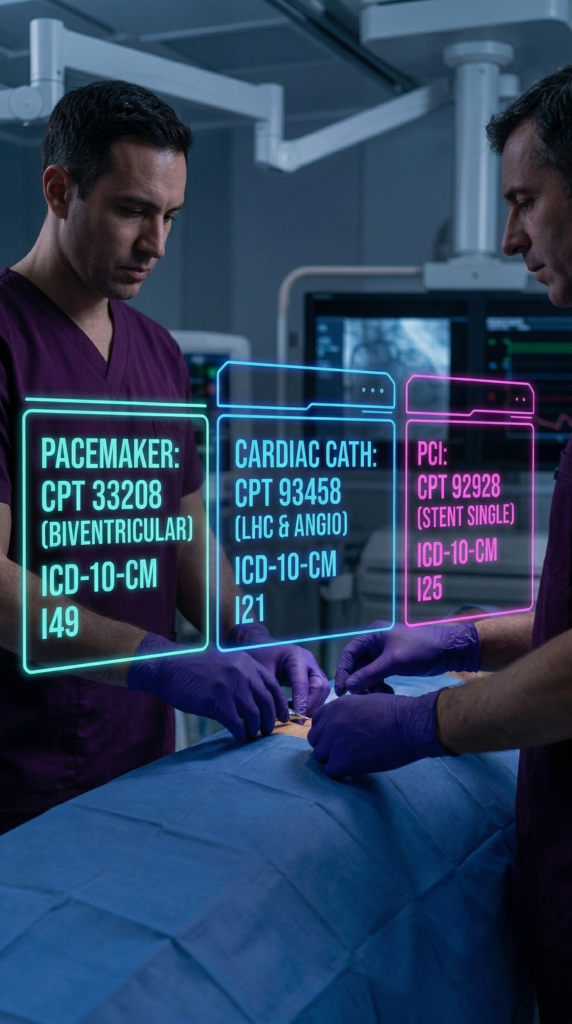
Cardiology CPT and ICD-10-CM Codes We Work With
Electrocardiogram
CPT 93000 covers routine EKG with interpretation and report. CPT 93005 is the tracing only, technical component. CPT 93010 is interpretation and report only, professional component.
Echocardiography
CPT 93306 covers transthoracic echocardiography complete with spectral and color flow Doppler. CPT 93307 is for transthoracic echo without Doppler. CPT 93308 covers follow-up or limited echo studies. CPT 93312 is for transesophageal echocardiography.
Stress Testing
CPT 93015 covers cardiovascular stress test complete, physician supervision, interpretation, and report. CPT 93016 is physician supervision only. CPT 93017 is tracing only. CPT 93018 is interpretation and report only.
Cardiac Catheterization and Angiography
CPT 93454 covers coronary angiography without left heart catheterization. CPT 93455 adds right heart catheterization. CPT 93456 covers coronary angiography with right heart catheterization. CPT 93458 is left heart catheterization with coronary angiography.
Enrollment Confirmation
Once approved, we confirm your active enrollment and effective date. Your billing team is notified right away so claims go out without any gap.
Percutaneous Coronary Intervention
CPT 92920 covers PCI of a single major coronary artery. CPT 92928 covers PCI with stent placement in a single vessel. CPT 92929 is for each additional vessel with stent placement.
Pacemaker and ICD
CPT 33206 covers insertion of single-chamber permanent pacemakers. CPT 33207 is for dual-chamber pacemaker insertion. CPT 33208 covers biventricular pacemaker insertion. CPT 33249 covers insertion of ICD with transvenous leads. CPT 93280 through 93284 cover pacemaker programming and follow-up.
Cardiac Rehabilitation
CPT 93797 covers cardiac rehabilitation without continuous ECG monitoring. CPT 93798 is with continuous ECG monitoring.
Cardiology Billing Problems We Fix Every Day
Our credentialing services support healthcare providers across the United States.
Prior authorization denied or missing
We track authorization requirements per payer and per procedure. Nothing gets billed without the right approval and supporting documentation in place.
Technical and professional components billed incorrectly?
We apply modifiers 26 and TC correctly based on how the service was performed and documented. No split-billing revenue gets missed.
Wrong catheterization or PCI code selected
We review the operative report and select the correct code based on vessel treated, approach used, and whether stenting was performed. Every interventional claim coded correctly.
Global period violation causing denial
We track global periods and apply modifiers 24 and 25 correctly when E&M services are provided during a post-operative period. No violation goes out unchecked.
Device implant claim underpaid
We code every component of the implant episode device, lead placement, and programming visits, separately and correctly. No device revenue gets bundled away.
EP study bundling denial
We apply modifier 59 when distinct EP services need to be separated and verify bundling rules before every submission.
Frequently Asked Questions
Cardiology involves high-value interventional procedures, catheterizations, PCI, device implants, EP studies, each with specific CPT codes, modifier requirements, global periods, and prior authorization rules. Payers scrutinize these claims heavily. One coding error on a high-dollar procedure means significant revenue lost.
Yes. We manage pre-authorization for every procedure that requires it, cardiac catheterizations, angioplasties, device implants, and valve replacements. Nothing moves forward without the right approval in place.
Modifier 26 indicates the professional component, physician interpretation, of a diagnostic study. Modifier TC indicates the technical component, equipment and staff. When a cardiologist interprets a study performed at a hospital facility both components must be billed separately. Getting this wrong means significant underpayment on every diagnostic study.
Yes. We handle the full device episode, implantation, lead placement, and follow-up programming visits. Every component is coded separately and correctly.
Every cardiac procedure has a global period, typically 10 or 90 days. E&M services provided during the global period require modifier 24 or 25 to be paid separately. We track global periods and apply the correct modifier every time.
Yes. EP studies, mapping, and catheter ablation have complex bundling rules. We code every component correctly and apply modifier 59 when distinct services need to be separated.
We identify the exact denial reason, authorization issue, modifier error, global period violation, or coding error, fix it at the source, and resubmit. Denial patterns are tracked so the same problem does not repeat.
Yes. Every workflow at GenMediTech follows strict HIPAA protocols, encrypted data handling and controlled access at every step.
Cardiology Revenue Lost to Billing Errors Is Revenue Your Practice Already Earned.
Missing prior authorization. Wrong catheterization code. Technical and professional components billed incorrectly. Global period violations. Device implant underpaid. Every one of these is money your practice earned and never collected.
Our cardiology billing specialists are ready to fix that, starting now.